
Reviewed · KUSADASI TOURS
From Kusadasi Port: Ephesus, Artemis & Virgin Mary Tour
Ephesus is the star here, and rightly so. You walk its marble streets past the Celsus Library, Temple of Hadrian, Agora, and huge theater where St. Paul preached. I like the reliable cruise-port pickup and the chance to pair the ruins with the quiet House of the Virgin Mary.
I also like the compact route, which fits several major sights into one shore day, and the guides’ strong record for clear, engaging history talks. The drawback is the shopping stop, which can feel pushy, and you must check whether entrance fees are included in your chosen $22 option.
Key points to know before booking
- Ephesus takes center stage: Expect the Celsus Library, Temple of Hadrian, Agora, marble streets, and Great Theater.
- Cruise timing is built in: Pickup and return are arranged around your ship, with a stated guarantee of on-time return.
- Guide quality is a major strength: Ali, Aydin, Errol, and other guides have been praised for strong local history and thoughtful explanations.
- The House of the Virgin Mary adds a religious dimension: It is a peaceful shrine, but entry may cost extra with some booking options.
- Artemis is now mostly ruins: The site matters because of its ancient fame, not because much of the temple remains.
- Shopping is part of the day: You may visit a carpet, leather, or ceramic workshop, so expect a sales presentation.
Why Ephesus makes this shore excursion worthwhile
From Kusadasi, Ephesus is close enough for a full visit, but far enough that a port excursion needs careful timing. This seven-hour trip handles the transport and route planning for you, leaving the main work to the guide: explaining what you are looking at and keeping the day moving.
I like this approach for a cruise stop. You do not need to arrange a taxi, negotiate several separate fares, or work out how to return to the port. Your guide meets you at the exit of the immigration gate, holding a sign with your name. Guides arrive 30 minutes early, so if you clear the gate before the rest of your party, wait in the stated meeting area.
The $22 starting price looks excellent for transport, guiding, and several stops. The important catch is the ticket choice. One option includes entrance fees and museum tickets, while another excludes them. If you choose the latter, your guide has skip-the-line Ephesus tickets, but you pay directly in euros, dollars, or Turkish lira. Check this detail before booking so the low headline price does not surprise you later.
More ways to see Ephesus:
- FOR CRUISERS: Skip The Lines PRIVATE EPHESUS TOUR &On Time Return
★ 5.0 · 8,527 reviews - Top Choice For Cruisers: Ephesus, Mary’s House WITH TICKETS+LUNCH
★ 5.0 · 7,233 reviews - PRIVATE EPHESUS TOUR FOR CRUISERS: On-time Return and Skip-Line
★ 5.0 · 5,807 reviews
Walking Ephesus from the Library to the Great Theater
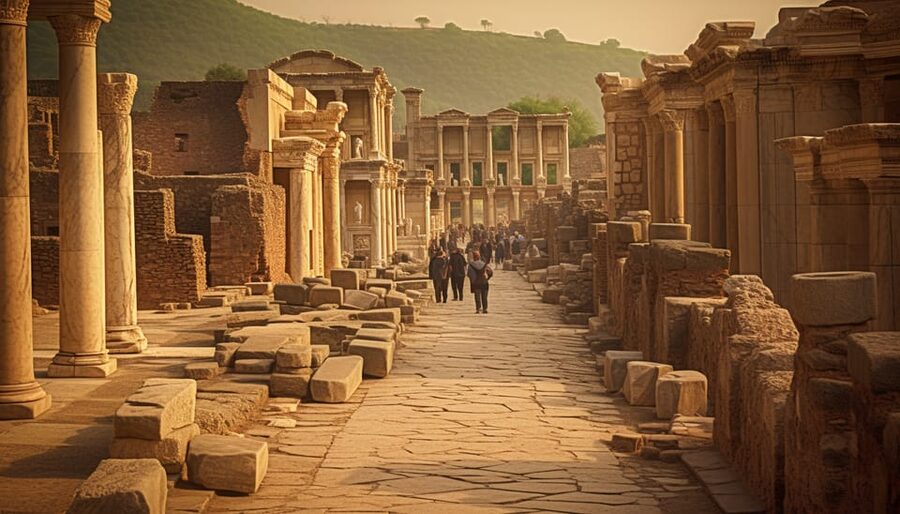
Ephesus works best when you let the guide connect the buildings into a story rather than treating each ruin as a separate photo stop. The city began as a Greek settlement and later became a major Roman center. Its surviving streets and public buildings give you a strong sense of how large and important it once was.
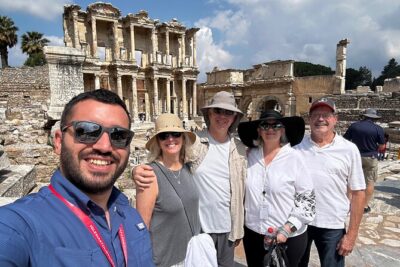
The Celsus Library is usually the visual highlight. Its two-story facade, with columns and carved details, is one of the most recognizable views in Turkey. Your guide can help you understand that the facade is the preserved front of a larger ancient building, not a complete library still packed with scrolls.
The Temple of Hadrian gives you another finely decorated Roman structure. Look for the ornamental details around the entrance and ask your guide how the emperor was honored in Ephesus. The Trajan Fountain, also included in the route, helps show how public waterworks and monuments shaped daily life in the city.
You will also pass through the Ancient Greek Agora. This was a public and commercial area, so it adds useful context to the grander monuments. Ephesus was not only a collection of temples and theaters. It was a working city with markets, civic spaces, religious buildings, and crowded streets.
The marble road leads toward the Great Theater, the largest and most dramatic stop in the ancient city. St. Paul is associated with preaching there, which gives the theater a strong place in early Christian history as well as Roman civic life. Even if you are not especially interested in religious history, the scale of the seating and stage area makes the stop worthwhile.
Plan for walking on uneven ancient surfaces. Comfortable shoes are essential, and sunscreen is sensible because the route includes exposed areas. Tripods are not allowed at Ephesus, but regular cameras are welcome. The tour is not suitable for wheelchair users or people with mobility impairments, so this is not the right choice if you need step-free access.
The House of the Virgin Mary and its quiet setting
After Ephesus, the route goes to the House of the Virgin Mary, also called the Shrine of Mother Mary. Christian tradition holds that Mary spent her final years here. It remains a pilgrimage site, and the mood is notably quieter than the main archaeological area.
You do not come here for grand architecture. The value is in the setting, the religious meaning, and the chance to pause after the long walk through Ephesus. I would treat this as a reflective stop rather than a second major ruin.
Be clear about admission. The published information says entrance is included only when you choose the ticket-inclusive option, and one account specifically found that the cost of entering the house was not properly understood in advance. This is easy to avoid: confirm the exact ticket arrangement before departure, and carry some cash in a usable currency.
The stop may also involve waiting while the guide handles entry. That is not necessarily a problem, but it can reduce your sightseeing time if the day runs late. Since the return to the ship matters, the guide should keep the schedule under control.
Artemis, one of the ancient world’s great names
The Temple of Artemis is a short but worthwhile stop because of what it once represented. It was counted among the Seven Wonders of the Ancient World, yet only a few remains survive today. You need to set your expectations correctly: this is not a towering temple visit like the Acropolis or a complete Roman monument.
What you see is valuable mainly because of the site’s fame and its place in the story of Ephesus. Your guide can explain the temple’s importance and help you picture the scale that is now missing. Without that explanation, the remaining stones and columns can seem underwhelming.
I like including Artemis because it gives the day historical range. Ephesus itself is mostly experienced through preserved urban ruins, while Artemis asks you to think about loss, reuse, and the fragile nature of ancient monuments. Keep this stop brief and let the guide supply the missing context.
A few more Kusadasi half-days to weigh up
- PRIVATE NO HIDDEN FEES Ephesus, Mary’s House Guided Tour /GRP OPT
★ 5.0 · 2,455 reviews - For Ship Guests:BEST SELLER EPHESUS PRIVATE TOUR & On Time Return
★ 5.0 · 2,029 reviews - ALL INCLUDED: Ephesus Ruins, Mary’s House Tour incl ENTRY TICKETS
★ 5.0 · 1,670 reviews - Ephesus Temple of Artemis and House of Mary Private Half Day Tour
★ 5.0 · 1,573 reviews
Isa Bey Mosque and Selcuk’s Turkish heritage
The tour also takes you past or to Isa Bey Mosque, a 14th-century building associated with early Turkish and Seljuk design. It provides a useful change of pace after the Greek and Roman remains.
The mosque is a reminder that the area’s story did not end with antiquity. Ephesus sits near Selcuk, a modern Turkish town shaped by several periods of rule and belief. The mosque’s inclusion helps place the archaeological sites within a broader regional story.
The exact wording of the schedule suggests that Isa Bey Mosque may be viewed as a pass-by stop, while the itinerary also lists it as a visit. Do not expect a long guided interior tour unless your guide confirms it. Its main value on this excursion is the contrast between classical ruins and medieval Turkish architecture.
The workshop stop: useful culture, possible sales pressure
The final cultural stop is a local artisan workshop. The guide chooses among ceramics, leather, or carpets based on group interest. This can be a good addition if you want to see how Turkish crafts are presented and learn about handmade goods.
It can also be the least comfortable part of the day. A leather visit may include a fashion presentation, while a carpet or pottery stop can turn into a sales pitch. One account described feeling followed and pressured to buy, with staff commenting on what the group could afford. That is not a minor detail if you dislike shopping stops.
You are not required to buy anything. Decide in advance that browsing is enough, and say so clearly. If you have limited time or no interest in Turkish crafts, ask your guide how long the stop will last. Some departures may also include a Turkish delight factory, though the formal route focuses on ceramic, leather, or carpet workshops.
This stop is part of the trade-off for the low price and broad cultural coverage. You get more than ruins, but you surrender some control over the afternoon.
Guides who make the ancient stones readable
The strongest feature of this tour is the guiding. The most praised guides include Ali, Aydin, Errol, and others, with repeated praise for their explanations, local knowledge, patience, and enthusiasm for the area.
Ali is described as especially strong at explaining the sites in detail and bringing history to life. Aydin is praised for local knowledge and a warm, patient manner. Errol is noted for offering useful insights into Ephesus. These names give you a sense of the standard reported by past participants, but you should not assume you will receive one particular guide.
A good Ephesus guide matters. The library, Agora, theater, and temples are impressive, but the ruins do not explain themselves. Dates, religious changes, civic life, and Roman customs can blur together without a clear narrative. The guide also helps you avoid wasting time at minor fragments when the major structures deserve attention.
English and Spanish tours are available. A private group option is also offered, which may suit families or groups that want more control over pace and questions. A standard group can sometimes be small, and one past booking became a group of only six people, creating a more personal day than expected. Group size is not guaranteed, so ask if this matters to you.
Timing, transport, and the cruise-ship safety net
The full outing lasts about seven hours, including pickup, sightseeing, shopping, and the drive back to Kusadasi Port. The schedule adjusts to your cruise arrival, which is important because port days do not always follow a normal land-tour timetable.
Pickup and drop-off are only available from Kusadasi Port. This is not a hotel tour or a general-day excursion from another part of the Aegean Coast. You need to be a cruise passenger and use the specified port meeting point.
The stated guarantee of on-time return is one of the tour’s biggest practical advantages. Independent transport can be cheaper in some cases, but a cruise passenger pays for certainty as much as for sightseeing. A guide who watches the clock and knows the port routine reduces the risk of a stressful return.
Bring your passport or ID card, comfortable shoes, and sunscreen. Beverages, lunch, and personal expenses are not included. Smoking is not allowed in the vehicle, and pets are not permitted.
Who should book this Kusadasi tour?
I would choose this trip if you want to see Ephesus properly but do not want to arrange port transport yourself. It suits first-time visitors who want a guide to explain the major monuments, cruise passengers who value a guaranteed return, and people interested in seeing both ancient and religious sites in one day.
It also suits anyone who likes a broad itinerary. You will see a classical city, a Christian shrine, the remains of a famous temple, a medieval mosque, and a Turkish craft workshop before returning to the ship.
I would think twice if you have difficulty walking on uneven ground, need wheelchair access, or strongly dislike commercial stops. The shopping portion may be shortened or handled firmly, but it remains part of the plan. I would also compare the ticket-inclusive price with the ticket-excluded price before deciding that $22 is the final cost.
Cancellation is free up to 24 hours before the tour, and you can reserve now and pay later. Those policies add flexibility, but the main decision is still about the route and the shopping stop.
Should you book it?
Book this tour if Ephesus is your priority and you want a well-organized shore day with a guide, transport, and several important nearby sites. The combination of strong guide feedback, cruise-focused timing, and a seven-hour route offers good value, especially when entrance fees are included.
Choose a different arrangement if you want a slow, purely archaeological visit without shopping, or if you need accessible transport and easier walking. Before paying, confirm the entrance-fee option and ask how much time is planned for the artisan workshop. With those points clear, this is a practical way to make the most of a single day in Kusadasi.
FAQ
Is this tour only for cruise passengers?
Yes. Pickup and drop-off are available only from Kusadasi Cruise Port, and the tour schedule adjusts to your cruise timetable.
Where does the guide meet me?
The guide meets you at the exit of the immigration gate at Kusadasi Cruise Port and holds a sign with your name.
How early does the guide arrive?
Guides arrive 30 minutes early. If you leave the immigration area before the guide is visible, wait at the stated meeting area.
How long does the tour last?
The tour lasts seven hours, including transportation and the return to Kusadasi Port.
Are entrance fees included?
Entrance fees and museum tickets are included only if you select the ticket-inclusive option. With the ticket-excluded option, the guide has skip-the-line Ephesus tickets, and you pay the guide directly.
Can I pay for excluded entrance tickets in dollars?
Yes. The guide accepts euros, dollars, or Turkish lira for the Ephesus entrance tickets when you choose the option that excludes entry fees.
What languages are available?
The tour is available with a live guide in English or Spanish.
Is a private group available?
Yes. A private group option is available.
Is lunch included?
No. Lunch, beverages, personal expenses, and anything not specifically listed as included are excluded.
Is the tour suitable for wheelchair users?
No. The tour is not suitable for wheelchair users or people with mobility impairments. Comfortable shoes are recommended because the Ephesus route includes ancient streets and uneven surfaces.
Just added around Kusadasi
- Kusadasi: Traditional Turkish Bath Experience★ 3.9 · 59 reviews
- Less Walking Private Ephesus, Virgin Mary, Temple Skip Lines★ 5.0 · 22 reviews
- Kusadasi Turkish Bath★ 3.6 · 51 reviews
- Kusadasi: Quad Safari Adventure★ 4.3 · 25 reviews
- Kusadasi: Turkish Bath Experience with Hotel Pickup★ 3.5 · 22 reviews
- Kusadasi: Ephesus Small Group Tour★ 4.9 · 26 reviews
- Kusadasi or Selcuk: Full-Day Ephesus Tour with Lunch★ 4.8 · 22 reviews
- Kusadasi: Pamukkale Hot Spring & Hierapolis Small-Group Tour★ 4.6 · 198 reviews
Kusadasi Tours, compared.
Skip The Lines PRIVATE EPHESUS TOUR &On Time Return
Read our review →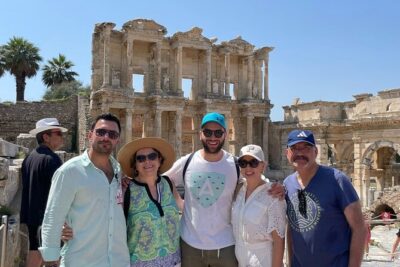
ALL INCLUDED: Ephesus Ruins, Mary’s House Tour incl ENTRY TICKETS
Read our review →
Ephesus Temple of Artemis and House of Mary Private Half Day Tour
Read our review →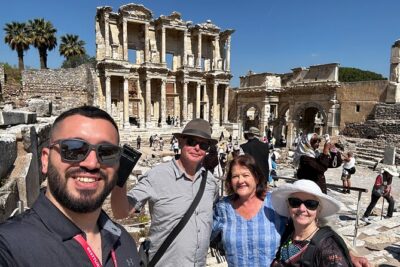
PRIVATE TOUR FOR CRUISERS: Mary’s House (Meryemana) and Ephesus
Read our review →
Top-Rated: Ephesus & Artemis Tour for Cruisers WITH ENTRY TICKETS
Read our review →
SKIP-THE-LINE: Group & Private Ephesus Tour ENTRY FEE & LUNCH
Read our review →Browse the lists this tour appears in