
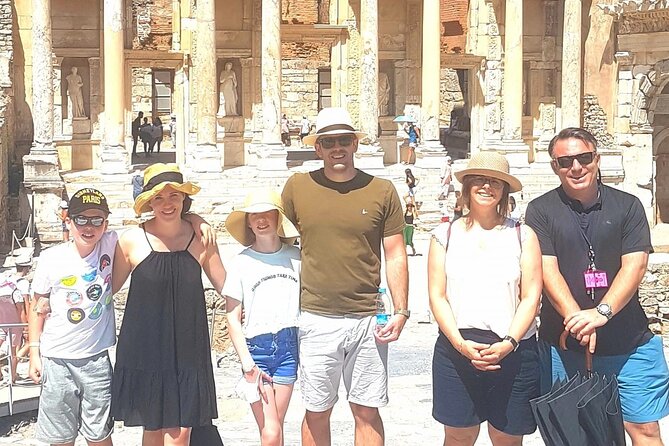
Reviewed · KUSADASI TOURS
SKIP-THE-LINE: Group & Private Ephesus Tour ENTRY FEE & LUNCH
Ephesus is the star here, and rightly so. You walk along marble streets past the Library of Celsus, Hadrian’s Gate, the Great Theatre, and the remains of a city that once ranked among the Roman world’s largest. I like the cruise-port pickup with a guaranteed return and the cool, private air-conditioned vehicle, especially on a hot Turkish day.
I also like the choice between a lower starting price and a more convenient ticket-included option, plus the chance to shape a private tour around your interests. The main consideration is the carpet and pottery shopping stops. They can be interesting, but you should expect sales presentations and costly merchandise.
Key points to know before booking
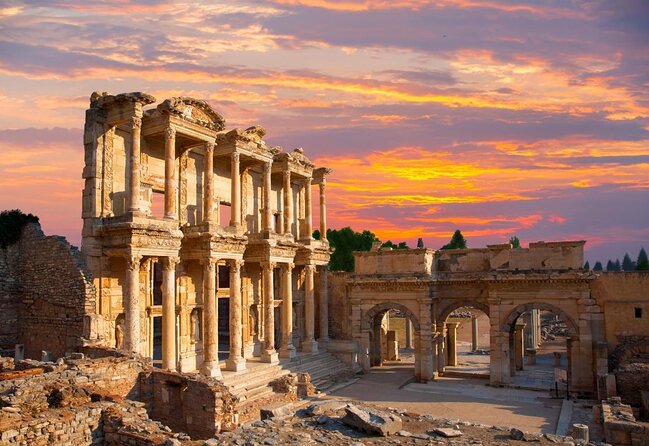
- Ephesus gets the proper spotlight: Allow about two hours among the marble streets, theatre, library, gates, fountains, and baths.
- Cruise timing is built into the plan: Pickup and return are arranged around your ship’s docking and boarding schedule.
- Private means private: The private option is reserved for your party, with a guide and driver in an air-conditioned vehicle.
- Lunch comes with a cultural stop: You eat at a carpet-weaving village and can watch artisans make Turkish rugs by hand.
- Ticket choices affect the real cost: The $7 starting price does not automatically include every entrance fee.
- The House of Mary is a personal choice: It matters deeply to many people, but the site’s tradition is based on belief and speculation rather than firm proof.
Why Ephesus is worth your limited port day
If you have only one day in Kuşadası, Ephesus gives you a powerful sense of place without requiring a long trip across Turkey. This was once a major harbor city with a population said to exceed 250,000 in the first century BC, and its surviving streets and public buildings still show the scale of that world.
The site is not a tidy collection of isolated ruins. You follow the old routes through a real ancient city, passing civic buildings, religious spaces, shops, fountains, baths, and grand avenues. That makes a guide especially useful. A good guide turns broken columns into a working city, explaining who used each place and why it mattered.
The tour provides about two hours at Ephesus. That is enough for the main sights, but it is not an unlimited archaeological visit. If you love ancient sites and want time for every inscription and side path, you may wish for longer. On the other hand, the schedule also includes Mary’s House, Artemis Temple, lunch, and craft stops, so the broad range is part of the appeal.
More ways to see Ephesus:
- FOR CRUISERS: Skip The Lines PRIVATE EPHESUS TOUR &On Time Return
★ 5.0 · 8,527 reviews - Top Choice For Cruisers: Ephesus, Mary’s House WITH TICKETS+LUNCH
★ 5.0 · 7,233 reviews - PRIVATE EPHESUS TOUR FOR CRUISERS: On-time Return and Skip-Line
★ 5.0 · 5,807 reviews
The main walk through Ephesus
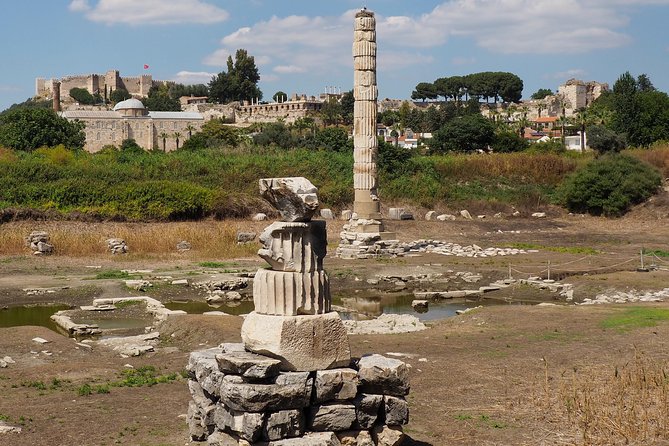
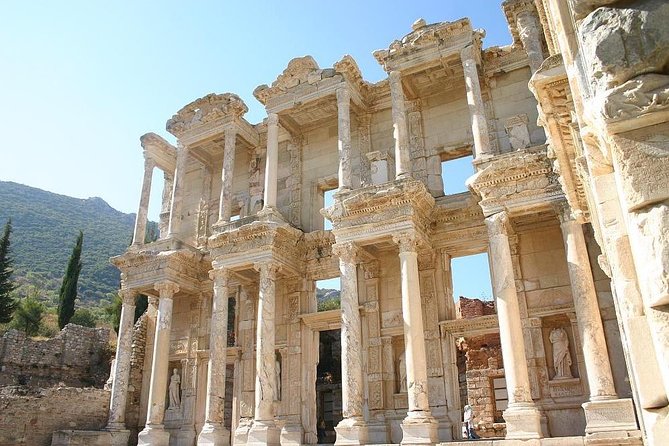
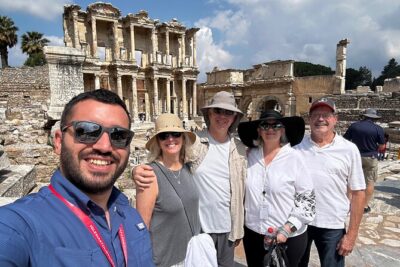
Your visit begins with the city’s major landmarks. The Library of Celsus is the visual centerpiece, with its decorated facade and strong sense of Roman civic pride. It was once one of the largest libraries of the ancient world, and the remaining front gives you a clear idea of how impressive the street must have looked.
Hadrian’s Gate adds another grand Roman touch. Along Marble Street and Harbor Street, you can picture processions, trade, and everyday movement through a city tied to the sea. The route also includes the local pharmacy reference, the Goddess Nike, and other carved details that are easy to miss if you hurry.
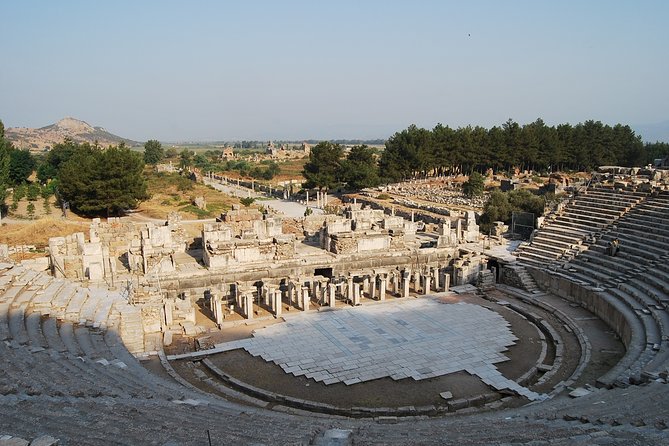
The Great Theatre is another highlight. Its reported capacity was more than 25,000 people, a huge number that helps explain Ephesus’s importance. You may also appreciate the acoustics, which make the structure feel less like a pile of stones and more like a place built for public life.
Wear sensible shoes. The walk includes ancient paving and steps, and some surfaces can be uneven. One guide, Oscar, was praised for helping with difficult steps and allowing time for photographs, while another guide, Vedat, was noted for being patient with mobility limits. Still, you should tell the company about any mobility concern before the day begins.
Summer heat is a real factor. Bring water, sun protection, and something to provide shade. The air-conditioned vehicle gives you a welcome break between stops, but the ruins themselves offer limited protection from the sun.
The Prytaneion, Pollio Fountain, and Roman baths
The shorter stops add useful detail to the main Ephesus walk. Behind the basilica, the Prytaneion was used for religious ceremonies, official receptions, and banquets. Its sacred flame was kept alight as a symbol of the city’s heart.
The remains date from different periods, with the original construction reaching back to the third century BC and later ruins linked to the Augustan age. The guide can point out the four-cornered pit connected with the sacred fire and explain how the ceremonial hall was arranged.
The Fountain of Pollio shows how the city handled water. Aqueducts brought supplies from several sources, including areas near Kuşadası, and clay pipes distributed water through public fountains. In a hot city, free water was not a minor luxury. It helped keep streets and residents supplied during the summer.
Some statues once connected with the fountain are now in the Ephesus Museum, including the head of Zeus and the group showing Odysseus and Polyphemus. You will not see those pieces here, but knowing where they went helps you understand why a partially empty ruin can still be significant.
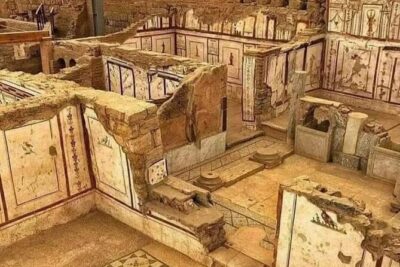
The Baths of Varius offer another glimpse of Roman daily life. Their three traditional sections were the frigidarium, tepidarium, and caldarium, meaning cold, warm, and hot rooms. The building dates to the second century AD, while corridor mosaics date to the fifth century. Excavation remains unfinished, so this stop is more about reading the layout than viewing a polished monument.
Lunch and the carpet-weaving village
Lunch takes place at a local carpet-weaving village, with time to see artisans working on Turkish rugs. This is a useful cultural contrast after the ruins. You get to see a living craft rather than only ancient stone, and the meal is described as plentiful and traditional.
Cold apple tea may be offered, and the food is included in the tour price. Beverages beyond what is provided are not included, so bring some Turkish lira or another payment method if you want drinks.
Here is the practical catch: the craft presentation can lead into a sales pitch. Handmade Turkish rugs and ceramics can be beautiful, but prices may be high, and the selling style can feel forceful. I would treat the stop as optional shopping time, not as a bargain-hunting opportunity.
Several itineraries also include a pottery or ceramic studio, and one guide arranged for a visitor to try the pottery wheel. That can be a memorable hands-on moment, but it is not listed as a guaranteed activity for every departure. If you do not want to shop, say so clearly and politely.
More lunch stops in Kusadasi:
- ALL INCLUSIVE Private Ephesus, House of Virgin Mary with lunch
★ 5.0 · 819 reviews - Ephesus: Mary’s House Private & Group Tour with Ticket+Lunch
★ 4.8 · 738 reviews - ALL INCLUSIVE Private Ephesus, House of Mary, LUNCH, Entrances
★ 5.0 · 735 reviews - Kusadasi & National Park Boat Tours with Lunch and Transfer
★ 4.3 · 585 reviews
The Temple of Artemis and the House of Mary
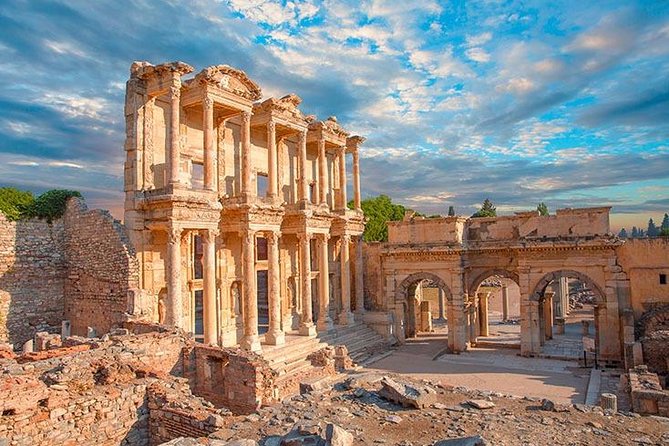
The Temple of Artemis is a quick stop, but it carries major historical weight. This Greek temple, also called the Artemision or Temple of Diana, was dedicated to Artemis and counted among the Seven Wonders of the Ancient World.
Do not expect a complete temple complex. The visit is brief, around 15 minutes, and the surviving remains are limited. Its value comes from the story and the location, especially when your guide explains the temple’s former scale and reputation.
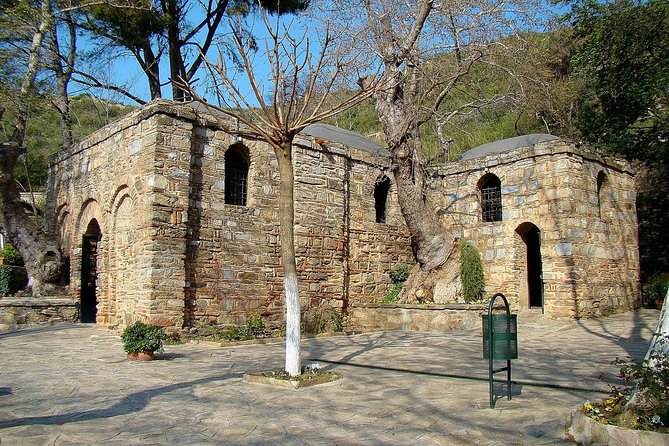
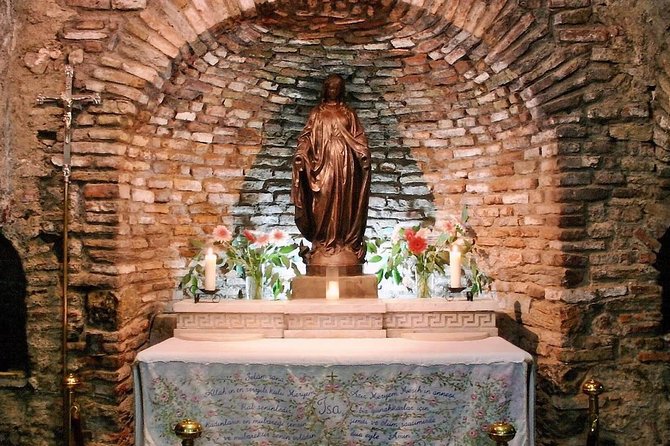
The House of the Virgin Mary is a different kind of stop. According to Christian tradition, Mary came to the Ephesus area with Saint John and spent her final years there. Many people find the small house moving and peaceful, while others prefer to view it as a place of religious tradition rather than established history.
That distinction matters. The identification is based on belief and speculation, so you should know what you are visiting before you arrive. The stop lasts about 45 minutes and includes an admission fee that is listed separately from the standard tour inclusions.
Private vehicle, group size, and timing
The transportation is one of the strongest practical features. You ride in a fully air-conditioned vehicle, and the private option is limited to your own party. That means you can discuss the pace, spend more time at Ephesus, or reduce time at a stop that does not interest you as much.
A small group also makes it easier to hear the guide and ask questions. One party of four described traveling in a comfortable minibus, while another appreciated being able to adjust the day around personal interests. If your cruise arrival changes, the company says it can adjust the pickup time.
The schedule lasts roughly four to six hours. That range is wide because timing depends on your ship, traffic, walking pace, and the selected stops. Pickup is at the cruise port exit, where you look for a board showing your reservation name.
The return promise matters more than it might on an ordinary day trip. This tour is designed specifically for cruise passengers, and the operator states that it will align the schedule with your docking and boarding times. You still need to give accurate ship details and return promptly when asked, but the structure is much safer than arranging an independent taxi with no local support.
What the $7 price really means
The advertised $7 rate is a starting price, not the full cost of every version. You need to check the exact option before paying, because entrance tickets may be excluded.
The listed entrance charges are €40 per person for Ephesus and TRY500 per person for the House of the Virgin Mary. The ticket-included option lets you pay these costs during booking, with the guide holding the tickets so you can skip the ticket queue at the ruins.
If you choose the ticket-excluded option, you can pay by cash or credit card on the day. For a private tour, you may also avoid paying for ruins you decide not to visit, according to the tour terms. That gives you more control, but it also means the final price is less simple.
Lunch, a licensed guide, and air-conditioned transportation are included. Drinks and tips are not. At the stated starting price, the tour can offer excellent value once the cost of transport, guiding, lunch, and entrance fees is compared with arranging each part yourself. Just do not mistake the headline figure for the all-in total.
The guides make a real difference
The strongest part of this experience is the human guide. Guides named Oscar, Tay, Adam, Ceyda, Charlie, Arzu, Erdam, Utdu, and Yesra received specific praise for warmth, patience, local knowledge, flexibility, or passion.
That matters at Ephesus. The ruins reward context, and the guide can draw your attention to small details such as the library’s less obvious features, the sacred fire at the Prytaneion, and the city’s water system. One useful tip is to ask about the secret door associated with the Library of Celsus.
The guide may also shape the order of stops around heat, crowds, and your ship’s schedule. You should still ask for a clear plan at the start, especially if you want the longest possible time at the archaeological site and less time at the shopping stops.
Who should book this Ephesus tour
I would recommend it most strongly to cruise passengers who want to see the major sights in one organized half-day. It suits first-time visitors, history fans, families who prefer a private vehicle, and anyone who values a guaranteed return to the port.
It also works well if you want both ancient ruins and modern Turkish culture. Ephesus supplies the archaeology, the carpet village supplies craft and lunch, and the House of Mary adds a religious stop.
I would hesitate if you want a strictly archaeology-only day. The shopping presentations may take more time than you prefer, and the House of Mary may not interest you. In that case, choose the private format and ask in advance whether the day can focus more tightly on Ephesus and the Temple of Artemis.
Free cancellation is available up to 24 hours before the local start time. The experience can also be changed or refunded if minimum numbers are not met or poor weather causes cancellation.
Should you book it?
Book this tour if your priority is a well-organized Ephesus day from a cruise ship, with lunch, transport, a guide, and the option to prepay entrance fees. The combination of a major archaeological site, the Temple of Artemis, Mary’s House, and Turkish crafts gives you a lot in four to six hours.
Choose the private option if you dislike fixed pacing, have mobility needs, or want to limit shopping time. Choose ticket inclusion if you want the simplest port day and do not mind paying the entrance charges in advance.
Skip it if you want to wander Ephesus alone for hours or have no interest in craft presentations. For most cruise passengers, though, the timing, transportation, and guide support make this a practical way to see one of Turkey’s great ancient sites without gambling on the ship’s departure schedule.
FAQ
Is this tour designed for cruise passengers?
Yes. Pickup and drop-off are available from Kuşadası Port, and the schedule is adjusted to your cruise docking and boarding times.
Is a timely return to the cruise port guaranteed?
The tour provider states that a timely return to the port is guaranteed. Pickup and return are planned around your ship’s schedule.
Is the tour private?
The private option is only for your party. A group option is also available, depending on the selection made when booking.
Are entrance tickets included?
Tickets are included only with the Entry Tickets Included option. With the ticket-excluded option, you pay entrance fees separately.
How much are the main entrance fees?
The listed Ephesus entrance fee is €40 per person. The House of the Virgin Mary entrance fee is TRY500 per person.
Is lunch included?
Yes. A deluxe lunch at a carpet-weaving village is included. Beverages are not included.
How long does the tour last?
The experience lasts approximately four to six hours, depending on the cruise schedule and the pace of the day.
Can I cancel for a full refund?
Yes, if you cancel at least 24 hours before the experience start time. Cancellations or changes made less than 24 hours in advance are not accepted for a refund.
More Skip the Line in Kusadasi
- All Inclusive Private Access Ephesus Tour (SKIP-THE-LINE)
★ 5.0 · 843 reviews - PRIVATE Ephesus and House of Virgin Mary Tour (Skip-The-Line)
★ 5.0 · 558 reviews - SKIP-THE-LINE: Group or Private Ephesus & Artemis Tour with LUNCH
★ 5.0 · 462 reviews - Kusadasi Port: All Inclusive Ephesus Tour (Skip-The-Line)
★ 5.0 · 54 reviews
Just added around Kusadasi
- Kusadasi: Traditional Turkish Bath Experience★ 3.9 · 59 reviews
- Less Walking Private Ephesus, Virgin Mary, Temple Skip Lines★ 5.0 · 22 reviews
- Kusadasi Turkish Bath★ 3.6 · 51 reviews
- Kusadasi: Quad Safari Adventure★ 4.3 · 25 reviews
- Kusadasi: Turkish Bath Experience with Hotel Pickup★ 3.5 · 22 reviews
- Kusadasi: Ephesus Small Group Tour★ 4.9 · 26 reviews
- Kusadasi or Selcuk: Full-Day Ephesus Tour with Lunch★ 4.8 · 22 reviews
- Kusadasi: Pamukkale Hot Spring & Hierapolis Small-Group Tour★ 4.6 · 198 reviews
Kusadasi Tours, compared.
Skip The Lines PRIVATE EPHESUS TOUR &On Time Return
Read our review →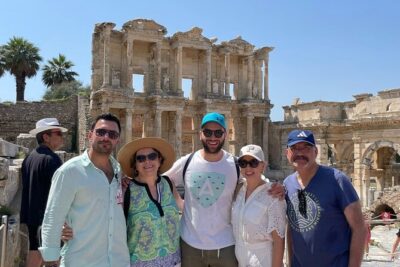
ALL INCLUDED: Ephesus Ruins, Mary’s House Tour incl ENTRY TICKETS
Read our review →
Ephesus Temple of Artemis and House of Mary Private Half Day Tour
Read our review →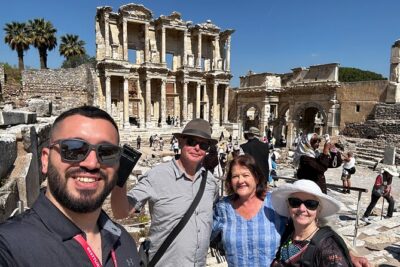
PRIVATE TOUR FOR CRUISERS: Mary’s House (Meryemana) and Ephesus
Read our review →
Top-Rated: Ephesus & Artemis Tour for Cruisers WITH ENTRY TICKETS
Read our review →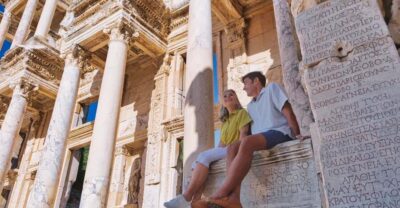
All Inclusive Private Access Ephesus Tour (SKIP-THE-LINE)
Read our review →Browse the lists this tour appears in