
Reviewed · ISTANBUL TOURS
2 Day Ephesus and Pamukkale Tour From Istanbul
Ephesus and Pamukkale make an impressive pair: one is a grand Roman city of marble streets and theaters, the other a white wall of mineral terraces above ancient Hierapolis. This two-day trip links both with flights from Istanbul, which saves you from arranging several separate transfers.
I like the all-in-one transport plan, including round-trip flights, airport transfers, local transport, admission fees, two lunches, and an overnight stay. I also like the small-group limit of 15 people, since that gives the guide a better chance to keep the day moving and answer questions.
The catch is the schedule. You may be collected around 4 a.m. on the first morning and return to Istanbul near midnight on the second day. That can mean roughly 44 hours away, with a large share spent at airports, on flights, in vans, or waiting for other members of the group.
Key points to know before booking
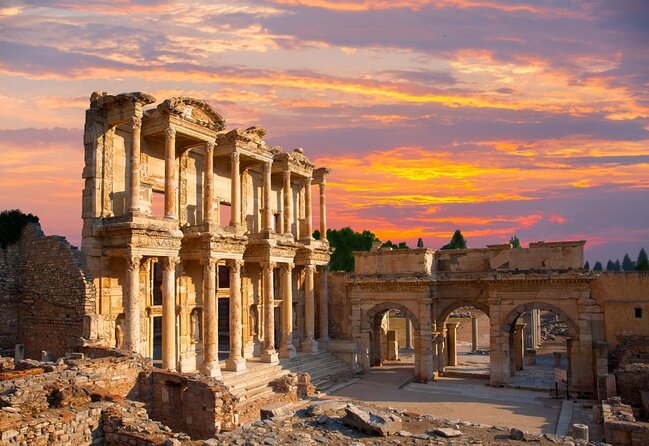
- Ephesus is the main event: Allow your energy for the Library of Celsus, Great Theatre, marble streets, and Temple of Hadrian.
- Pamukkale is beautiful but slippery: The shallow terraces are often crowded, and walking barefoot requires care.
- The package saves planning time: Flights, hotel, guides, transfers, lunches, and entrance fees are bundled together.
- The first morning starts very early: Istanbul hotel pickup can begin at about 4 a.m.
- The overnight stay is in Selçuk or Kuşadası: Accommodation quality can vary, so do not assume an upscale hotel.
- Shopping stops may reduce sightseeing time: Ask in advance if cultural workshops or sales visits are part of your day.
Two UNESCO sites packed into one tiring trip
This is a sightseeing sprint, not a slow regional holiday. You leave Istanbul for the Aegean coast, see Ephesus and several nearby places on the first day, sleep around Selçuk or Kuşadası, then head inland to Pamukkale and Hierapolis before flying back.
That format makes sense if you have only two days and want to cover Turkey’s major ancient sites without booking trains, flights, hotels, and local taxis yourself. It makes less sense if you value relaxed mornings, long meals, or the freedom to choose exactly how long you spend at each ruin.
The advertised price is $843.35 per person. That is a serious sum for two days, but it includes several costly pieces: domestic flights with taxes, airport transfers in Istanbul and western Turkey, local transport, accommodation, guides, lunches, and entrance fees. The value depends on execution. If the pickups are punctual and the connections work, you are paying for convenience. If you spend hours waiting or receive a low-grade hotel and rushed guiding, the package becomes much harder to justify.
The group limit is 15 people. That is small enough to feel more personal than a large coach tour, though it does not guarantee a perfectly smooth day. The practical weak point is coordination. Different flight times, delayed pickups, and waiting for other participants can eat into the hours you expected to spend at Ephesus.
More ways to see Ephesus:
- 4 Days Turkey Tour – Cappadocia, Ephesus and Pamukkale Tour
★ 5.0 · 138 reviews - 6 Days Turkey Tour Cappadocia, Pamukkale, Ephesus, Gallipoli Troy
★ 5.0 · 109 reviews - Daily Ephesus & House of Virgin Mary from Istanbul – Small Group
★ 4.0 · 95 reviews
Ephesus: the strongest reason to go
Ephesus deserves the long journey. Once an important Greek and Roman city, it now offers one of the clearest views of urban life in the ancient Mediterranean. You walk along broad marble streets past columns, public buildings, mosaics, and monumental facades.
The Library of Celsus is the visual star. Its reconstructed front gives you a strong sense of the scale and decoration ancient cities once displayed. The Great Theatre is just as memorable, with steep seating and a size that helps you imagine public speeches, performances, and political gatherings.
The Temple of Hadrian, marble streets, and surviving architectural details fill out the picture. Ephesus is not a single monument you glance at and leave. It works best when your guide explains how the buildings connected, who used them, and why the city mattered.
The listed time for the Ephesus portion is 13 hours, but that appears to cover the broader day, including transport and the other stops. Actual time inside the ruins may be much shorter. One major warning is heat. A late start in July can turn an otherwise fascinating walk into a hot, tiring march, especially on exposed stone with little shade.
Wear shoes with a firm grip, bring water, and use sun protection. The ancient streets are uneven, and you will enjoy the site more if you are prepared for a lot of walking.
The Temple of Artemis: a quick look at a vanished wonder
The Temple of Artemis takes about 30 minutes and has no separate admission charge. It was one of the Seven Wonders of the Ancient World, built in honor of Artemis and known in antiquity for its huge scale and marble sculpture.
Today, the remains are spare. One standing column and scattered fragments are a long way from the grand temple described in ancient accounts. I would treat this as a short historical stop, not a major attraction on the level of Ephesus.
It is still worth seeing because the contrast is useful. Ephesus shows you a city with substantial ruins. The Temple of Artemis asks you to picture what is gone. Your guide’s explanation matters here, since the site itself cannot tell the story through surviving buildings.
The House of Virgin Mary: meaningful for some, optional for others
The House of Virgin Mary sits on the slopes of Mount Koressos near Ephesus. Christian tradition holds that Mary lived here after being brought to the area by the Apostle John. The small stone building, chapel, gardens, candles, and prayer area give the place a quiet religious character.
This stop takes about an hour and includes admission. It has significance for both Christian and Muslim visitors, but its appeal is personal rather than archaeological. If you are interested in pilgrimage sites, early Christianity, or the traditions connected with Mary, you may find the visit worthwhile.
If your main goal is ancient architecture, the house may feel less rewarding than extra time at Ephesus. One practical question to ask before departure is how firmly this stop is fixed in the schedule. On a very compressed day, an optional-feeling visit can make the central ruin feel even more rushed.
A few more Istanbul half-days to weigh up
- Istanbul: 1 or 2-Day Hop-On-Hop-Off Bus Tour Ticket
★ 4.1 · 863 reviews - Istanbul: 1 or 2-Day Private Guided Tour with Hotel Transfer
★ 4.7 · 438 reviews - From Istanbul: 2-Day All-Inclusive Cappadocia Guided Trip
★ 4.9 · 380 reviews - Istanbul: 2-Day Cappadocia Trip with Flights and Cave Hotel
★ 4.7 · 318 reviews
Isa Bey Mosque connects several eras
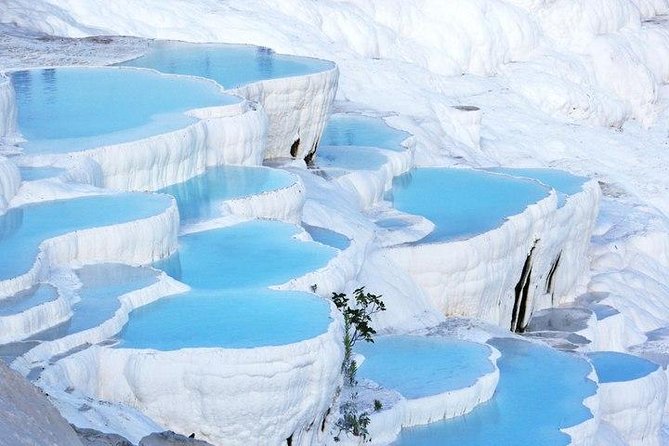
The 14th-century Isa Bey Mosque is close to the Temple of Artemis and the Basilica of St. John. Its asymmetrical design, marble and stone work, courtyard, domes, and calligraphy show a later chapter in Selçuk’s story.
The mosque is partly ruined but remains an active place of worship. That makes it more than a photo stop. You are seeing a building that still has a living function, not only an archaeological shell.
The visit takes about an hour and is included at no extra charge. Its location makes it a useful bridge between the ancient Greek and Roman remains around Selçuk and the Seljuk and Aydinid periods that followed. Dress and behave respectfully, since this is a religious site.
Şirince gives the day a village pause
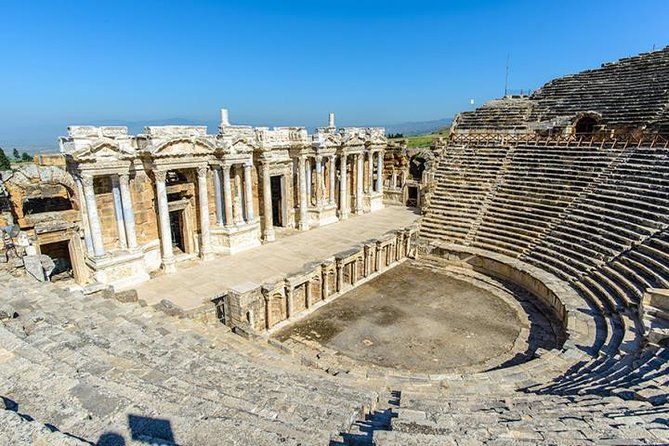
Şirince is a hill village known for narrow cobbled lanes, whitewashed houses, wooden shutters, cafes, artisan shops, and fruit wines made from peaches, mulberries, cherries, and other local produce. After the stone-and-column scale of Ephesus, it offers a more modest view of the region.
The stop lasts about an hour. You can walk, take photographs, browse, and possibly taste local wines, though the schedule may steer you toward particular shops. The village views are one of its pleasures, but the commercial side deserves attention.
Some organized tours include cultural workshops or shopping visits where a short demonstration leads into a sales pitch. That is not automatically a bad thing, but it can take time from Ephesus or Pamukkale. Ask what is planned before you board the van, especially if you prefer ruins and local streets to retail stops.
The overnight stay: convenience with uneven standards
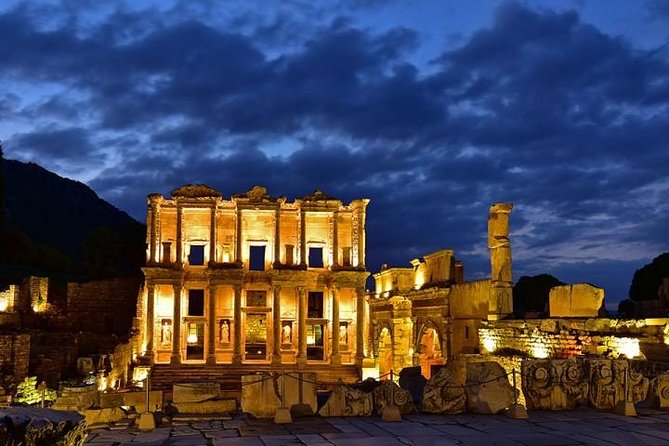
The overnight stay is in Selçuk or Kuşadası, depending on the arrangement. Accommodation is included, which saves you from finding a room after a long first day and helps make the flight-and-tour combination workable.
The standard is not consistent enough to assume a boutique hotel. One reported stay was clean and functional but hostel-like, while another was described as poor and dirty. The Hatit Hotel in Selçuk was specifically criticized for basic conditions.
That does not mean every booking will be uncomfortable. It does mean you should ask for the confirmed hotel name before paying, then check what room arrangement is provided. This matters if you are traveling with a friend, since room setups can vary. The operator has also explained that holiday periods can make one-night rooms harder to secure.
Breakfast is not included. The package does include two lunches, but no morning meal, so plan for the early departure and the second morning. Drinks are also not included, including water, and alcoholic drinks can be purchased separately.
Pamukkale: beautiful, crowded, and easy to underestimate
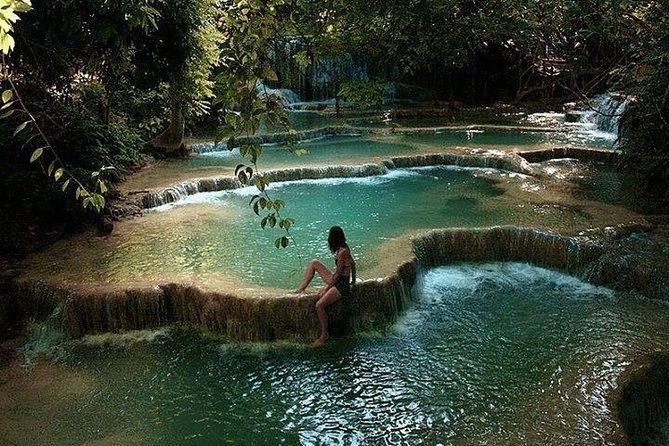
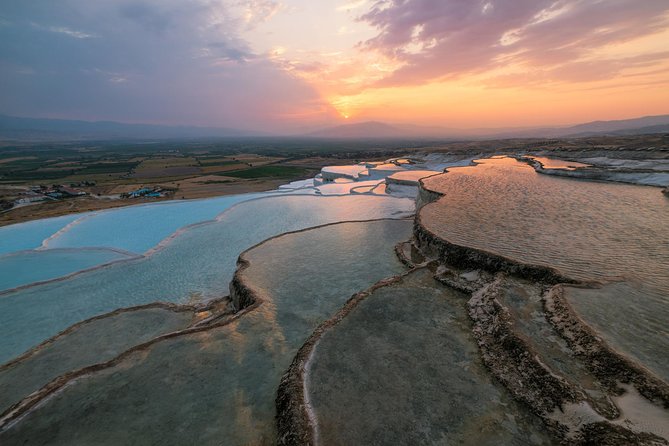
Pamukkale means Cotton Castle, a fitting name for the white travertine terraces that cover the hillside. Calcium-rich thermal water has formed shallow pools and bright mineral shelves, producing a scene unlike Ephesus or any other stop on this route.
The site is visually striking, but social media can create false expectations. The terraces are often crowded, the pools may be only about two feet deep, and some areas are closed or unsuitable for swimming. You may spend more time walking and looking than soaking.
The surface is also very slippery. You generally remove your shoes in the travertine area, and bare feet on wet mineral surfaces demand slow, careful steps. Do not rush for a photograph. A fall here can ruin the rest of your trip.
The Pamukkale portion is listed as a 13-hour stop, but that includes the long drive from the coast, the ruins, the terraces, and the return journey toward the airport. One account describes the drive to Pamukkale as about three hours. That is another reason to protect your energy on day one.
Hierapolis: the ruins above the terraces
Hierapolis sits beside Pamukkale and adds the historical weight that the terraces alone cannot provide. Founded in the second century BCE, it became a Roman spa city built around hot springs believed to have healing qualities.
The Roman theatre is a major highlight, with surviving decoration and a strong setting above the white terraces. The necropolis gives you a sense of the city’s size and importance, while temples and the sacred Plutonium point to the religious side of the spa complex.
The combined visit to Hierapolis and Pamukkale is listed at about two hours, with admission included. That is not much time for a site this broad. If you are interested in Roman archaeology, stay close to the guide and ask which ruins are being prioritized.
The quality of the explanation can make a large difference. Some tours have excellent local guides who keep the ruins clear and lively. Others have suffered from weak commentary, particularly at the Roman site. The package promises guiding, but the actual experience depends heavily on the assigned guide and the day’s coordination.
Cleopatra’s Pool: pay attention to what is included
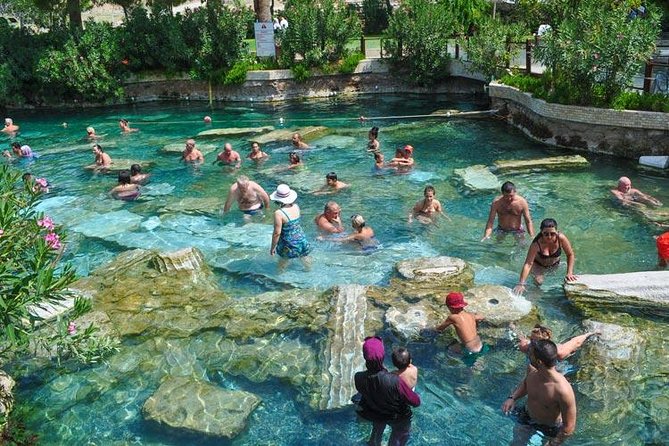
Cleopatra’s Pool is a warm thermal spring, said to remain near 36°C year-round, with fallen marble columns beneath the water. The setting links bathing, ancient ruins, and the healing culture of Hierapolis.
Admission is included in the package, but that does not necessarily mean every optional activity or personal purchase is covered. Confirm the current arrangement if swimming is important to you. The pool is listed for about two hours, though that time may overlap with the wider Pamukkale and Hierapolis visit.
The famous connection to Cleopatra and Mark Antony is a legend, not a reason to expect a private royal bath. You will be sharing a popular site, and the pool can be busy. Still, the combination of warm water and ancient columns is unusual enough to be memorable if you have the time and energy.
Flights and transfers are where the tour earns its keep
The package includes round-trip flights from Istanbul, with flight taxes and baggage limits of 15 kilograms plus an 8-kilogram handbag. Istanbul hotel pickup is offered from city-center hotels, and transfers are also arranged for the Izmir and Pamukkale airports.
This is the tour’s clearest practical benefit. You do not have to compare domestic flights, arrange taxis, find a hotel, and negotiate local transport around Selçuk and Pamukkale. For a first visit to Turkey, that can remove a lot of stress.
But convenience only works when communication is sharp. Some arrangements have involved long airport waits, unclear instructions about obtaining flight tickets, late local pickups, and confusion about the return transfer. One return to Istanbul included an extended wait before the driver was located.
I would save the operator’s phone and WhatsApp contact, confirm every pickup time, and ask which airport you are using. Do this before the first morning, not while standing in an unfamiliar terminal at dawn.
Food, shopping, and the true value of $843.35
Two lunches are included, generally buffet-style. Food quality can be basic, and drinks are extra. Breakfast is not provided, so the package is not a full-board plan.
At $843.35, the tour is not competing with a budget DIY trip. You may spend less by booking flights, a modest hotel, local day tours, meals, and entrance fees separately. The package is aimed at people who place a high value on one booking and organized transfers.
I would pay the premium only if the schedule and service are confirmed clearly. Ask for the airline and flight times, the hotel name, the expected time at Ephesus, the Pamukkale departure plan, and whether shopping workshops are included. Those answers tell you more about value than the headline list of inclusions.
The tour has a 4.5 rating from 28 posted ratings, with praise for punctual transport, clear communication, good guides, and friendly group dynamics. Solo visitors may enjoy the built-in social side, since the small group gives you company during long transfers. At the same time, the low ratings point to real risks involving budget lodging, late pickups, weak explanations, and wasted time.
Who should book this two-day route?
I would recommend it to you if you have very limited time in Turkey, want both major sites, dislike planning domestic transport, and can handle long days. It also suits first-time visitors who prefer a guide to explain the ruins rather than piecing together the history alone.
It is less suitable if you want high-end accommodation, flexible sightseeing, quiet time at Pamukkale, or control over your meals and flights. It is also a poor fit if you struggle with very early starts or long waits.
The cancellation terms are reasonable: you can cancel up to 24 hours before the start for a full refund. Weather can also affect the experience, with a different date or full refund offered if the tour is canceled because of poor conditions.
Should you book it?
Book this tour for maximum coverage with minimum planning, not for a leisurely escape. Ephesus and Pamukkale are worth seeing, and the included flights and transfers can save you a great deal of organizing.
Before booking, get the hotel, flight schedule, pickup times, and shopping policy in writing. If those details look solid and your two-day window is tight, the convenience may justify the price. If you have extra days, I would arrange the route yourself or stay longer in Selçuk and Pamukkale. You will likely see more, wait less, and have a better chance of choosing the hotel and meals that suit you.
FAQ
Where does the tour pick me up in Istanbul?
Pickup is offered from any hotel in Istanbul city center. Istanbul airport transfers are included.
Are flights included in the price?
Yes. Round-trip flight tickets with taxes are included, along with a baggage allowance of 15 kilograms plus an 8-kilogram handbag.
Where do I stay overnight?
The overnight accommodation is arranged in Selçuk or Kuşadası. The specific hotel should be confirmed before booking or departure.
Are meals included?
Two lunches are included. Breakfast and drinks are not included, and alcoholic drinks are available to purchase separately.
How large is the tour group?
The tour has a maximum of 15 participants.
Can I cancel for a full refund?
Yes. You can cancel at least 24 hours before the experience start time for a full refund. Changes or cancellations made less than 24 hours before the start are not accepted for a refund.
Just added around Istanbul
- istanbul airport transfer★ 3.5 · 43 reviews
- Flying Dress Photography on an Iconic Rooftop in Istanbul★ 5.0 · 87 reviews
- Istanbul Private Guiding Service★ 5.0 · 68 reviews
- Best Istanbul tour with private guide by skipping ticket line★ 5.0 · 103 reviews
- Food Tour in Istanbul with Local Guide★ 5.0 · 37 reviews
- istanbul old city private tour★ 5.0 · 19 reviews
- Istanbul Private Tour (Licensed Guide)★ 5.0 · 17 reviews
- Istanbul Airport (IST) To Hotels Transfer★ 5.0 · 80 reviews
Istanbul Tours, compared.
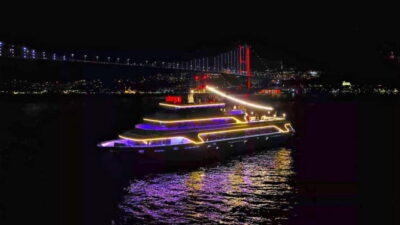
Bosphorus Dinner Cruise & Show with Private Table
Read our review →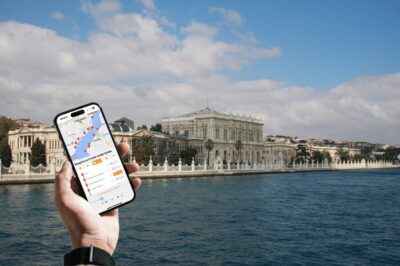
Daytime or Sunset Sightseeing Cruise & Audio Guide
Read our review →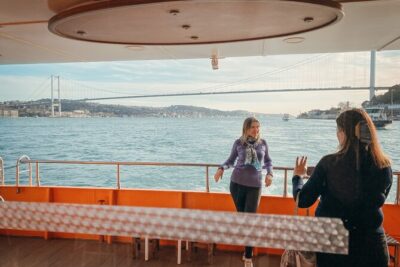
Bosphorus Dinner Cruise with Turkish Night Show
Read our review →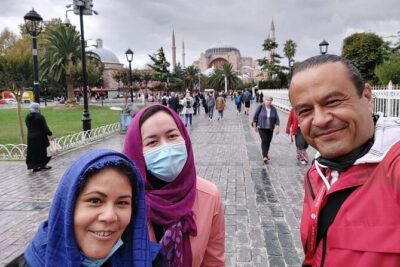
Best of Istanbul 1, 2 or 3-Day Private Guided Istanbul Tour
Read our review →
Basilica Cistern Fast-Track Entry and Audio Guide
Read our review →
Hagia Sophia Skip-the-Line Ticket & Museum Option
Read our review →
Hodjapasha Whirling Dervishes Show & Exhibition
Read our review →
Topkapi Palace & Harem Museum Ticket & Audio Guide
Read our review →Browse the lists this tour appears in