
Reviewed · TURKIYE
In The Footsteps Of Rumi
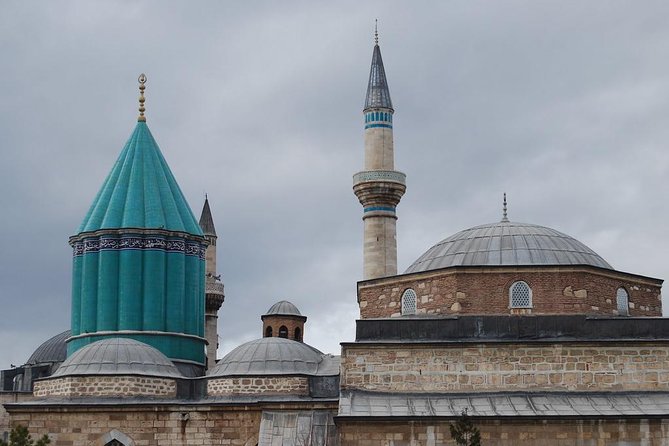
Konya’s most moving sight is the turquoise-domed Mevlana Museum, but Rumi’s story makes more sense when you follow it across the city. This private tour links his tomb with the people, mosques, kitchens, and meeting places that shaped his spiritual life. The gold bazaar connection is especially memorable: tradition says the sound of hammers striking gold sheets inspired Rumi to whirl.
I like the private format, which gives your guide room to explain Sufism and answer questions without a large group crowding the conversation. I also like the mix of famous and modest sites, from Shams-i Tebrizi’s tomb to the memorials of Rumi’s cook, doctor, and childhood nanny. The main consideration is pace: six to eight hours, several short stops, walking, and vehicle transfers make this a full day rather than a quick museum visit.
Key Points To Know Before You Book
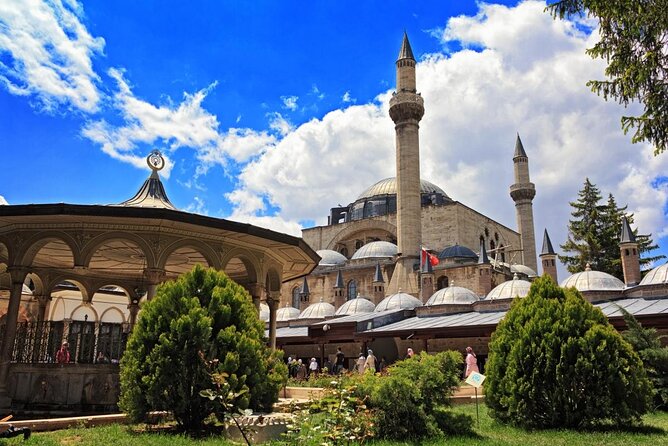
- Rumi’s turquoise-domed tomb: Spend about two hours at the Mevlana Museum, the former Mevlevi dervish lodge and Konya’s essential sight.
- A personal look at Sufism: Guides such as Hayri, Fatma, Hüseyin, and Belkis explain Rumi’s teachings, poetry, and connection to the Mevlevi order.
- More than the main museum: Visit Shams-i Tebrizi, Iplikci Mosque, Ateşbaz-ı Veli, and smaller tombs tied to Rumi’s circle.
- A private day with lunch included: Your group travels by private transport, and the price includes lunch, entrance fees, and professional guiding.
- A useful time commitment: Plan on six to eight hours, with pickup offered and a start window listed from 9:30 a.m. to 4:30 p.m.
- Best for curious visitors: This suits anyone who wants spiritual and cultural context, not just a quick look at Rumi’s grave.
Why Rumi’s Konya Is More Than One Famous Tomb
Most people arrive in Konya for Mevlana Celaleddin-i Rumi, the 13th-century poet, saint, and mystic whose teachings shaped the Mevlevi order. His name is now known around the world, often linked with poetry about love, tolerance, and spiritual transformation.
The city gives you a more grounded way to understand him. Instead of treating Rumi as a distant literary figure, this tour places him in the streets and institutions of medieval Konya. You see where he taught, where his closest companion Shams lived and was honored, and how the Mevlevi tradition connected spiritual practice with ordinary work.
I would choose this tour if you want interpretation rather than a simple checklist of sights. The guides are central to the experience. Hayri is praised for clear English and strong knowledge of Rumi and the Mevlevi order. Fatma is described as thoughtful and able to combine stories with historical facts. Hüseyin brings in the Seljuk period, while Belkis is noted for her passion and for taking people to less familiar places.
The quality may vary slightly by assigned guide, but the repeated pattern is clear: the tour depends on a person who can explain both the facts and the spiritual meaning. That is a good reason to ask who your guide will be when you book, especially if language and religious context matter to you.
Other Turkey days that get booked on the same trip:
- Istanbul: Bosphorus Dinner Cruise & Show with Private Table
★ 4.8 · 44,561 reviews - Istanbul: Daytime or Sunset Sightseeing Cruise & Audio Guide
★ 4.8 · 14,430 reviews - Istanbul: Bosphorus Dinner Cruise with Turkish Night Show
★ 4.8 · 10,127 reviews
Entering the Mevlana Museum Under the Turquoise Dome
Allow about two hours for the Mevlana Museum, the heart of the day. This was once the lodge of the whirling dervishes and remains the place most closely tied to Rumi’s memory.
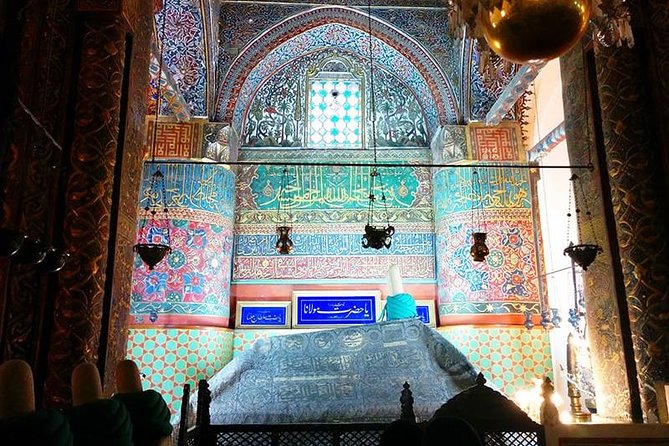
The building’s fluted turquoise dome is one of Turkey’s most recognizable sights. It gives the museum a strong visual identity before you even enter, but the real focus is inside: Rumi’s tomb. Paying respects here can feel solemn, even if you are not Muslim. The setting invites quiet attention rather than a rushed photograph.
Your guide can help you understand the difference between the building as a museum and its continuing importance as a Sufi center. That distinction matters. You are not simply seeing an old monument. You are entering a place connected to prayer, teaching, ritual, music, and the formation of the Mevlevi dervish tradition.
The museum is also the best place to ask basic questions about Sufism. You can learn about the Mevlevi order, the meaning behind whirling, and the way Rumi’s religious life sits alongside his poetry. The tour’s value rises sharply here if your guide can connect the objects and rooms to those ideas.
Give yourself time to observe the mood. This is not a stop to race through. Modest clothing and respectful behavior are sensible, since the site is associated with Rumi’s tomb and Muslim devotion.
Alaeddin Tepesi and Rumi’s First Meeting With Shams
The next stop at Kultur Park and Alaeddin Tepesi is brief, listed at about five minutes, but its story is important. This is identified as the first meeting place of Rumi and Shams-i Tebrizi.
Rumi’s relationship with Shams changed the course of his life and work. Shams was not simply a friend or teacher. He became Rumi’s spiritual guide, inspiration, and companion. Their connection helps explain why Rumi’s poetry took on such emotional force and why Shams remains central to any serious account of Rumi.
Because the stop is short, do not expect a long visit or a major monument. The value lies in the explanation. Your guide can place the meeting within Konya’s Seljuk-era setting and show how a location can matter because of the event associated with it.
This is also a good example of why private transport helps. The tour covers several sites spread across Konya, and the schedule would be harder to manage if you had to arrange every transfer yourself. You get a quick stop, a focused explanation, and then move on.
Iplikci Mosque and the Lost Altunaba Madrasah
Iplikci Mosque dates to 1202 and gives you a tangible link to Konya’s Seljuk period. The adjacent Altunaba Madrasah, once associated with Rumi as his school, no longer survives, so the mosque carries much of the visible connection.
The stop lasts about 15 minutes. That is enough for a concise explanation and a look at the mosque, but not enough for a long architectural study. I like this stop because it keeps Rumi connected to teaching and scholarship, not only mysticism and poetry.
The vanished madrasah is worth noting. A missing building can be as revealing as a surviving one. It reminds you that modern Konya contains layers of a city whose medieval institutions have changed, disappeared, or been absorbed into later development.
Your guide may also connect Iplikci Mosque to the wider Seljuk story of Konya. That context helps you see Rumi as a person living within a particular city and culture, rather than as an isolated spiritual celebrity.
Same base, a completely different sort of day:
- Best of Istanbul 1, 2 or 3-Day Private Guided Istanbul Tour
★ 5.0 · 8,922 reviews - FOR CRUISERS: Skip The Lines PRIVATE EPHESUS TOUR &On Time Return
★ 5.0 · 8,527 reviews - Istanbul: Basilica Cistern Fast-Track Entry and Audio Guide
★ 4.6 · 7,521 reviews - Top Choice For Cruisers: Ephesus, Mary’s House WITH TICKETS+LUNCH
★ 5.0 · 7,233 reviews
Shams-i Tebrizi’s Tomb and the Gold Bazaar
The visit to Sems-i Tebrizi Tomb and Mosque is one of the most meaningful parts of the route. Shams was Rumi’s spiritual companion, and his tomb is among the key places to visit if you want to understand Rumi’s transformation.
The site is followed by a visit to Konya’s historic gold bazaar, with about 40 minutes assigned to this part of the route. According to local tradition, Rumi began to whirl after hearing goldsmith apprentices hammering sheets of gold. The story turns a simple commercial sound into part of Mevlevi memory.
That connection is wonderfully human. It links spiritual movement to the noise of work, trade, and craft. You do not have to treat every traditional account as a proven historical fact to appreciate what it says about the way Konya remembers Rumi.
The bazaar also gives the day a change of rhythm. After tombs and mosques, you encounter a place tied to ordinary business. I would pay attention to how your guide handles the story, distinguishing tradition from documented fact while still explaining why the tale has lasted.
This stop may appeal most to visitors who want local texture. It is not only about Rumi’s major dates and teachings. It shows how stories survive through places, sounds, and working communities.
Ateşbaz-ı Veli and the Spiritual Importance of the Kitchen
Ateşbaz-ı Veli was Rumi’s cook, but his role reaches beyond the household detail. The Mevlevi dervish houses placed great importance on Matbah-ı Şerif, the sacred kitchen, and Ateşbaz-ı Veli represents the authority connected with that part of the order.
You spend about 30 minutes at his tomb. Your guide can explain how the kitchen functioned within Mevlevi life and why cooking was treated as more than background labor. Food preparation, discipline, service, and community all had a place in the order’s daily structure.
This is one of the route’s most useful stops because it broadens your idea of spiritual practice. Rumi’s world was not made only of sermons and poetry. It also relied on people who cooked, taught, cared for others, and kept a religious community working.
I appreciate that the tour includes a figure who might otherwise be overlooked. If you visited only the Mevlana Museum, you could leave with a narrow picture centered on Rumi himself. Ateşbaz-ı Veli shows you the network of people who helped sustain the Mevlevi tradition.
The Doctor’s Tomb and a More Personal Side of Rumi
Back at Kultur Park and Alaeddin Tepesi, you visit the tomb of Tabib Ekmeluddin. He was Rumi’s doctor and one of the best-known physicians of the 13th century.
The stop is listed at about 15 minutes. It is not a major museum visit, and the tomb may be most meaningful when your guide explains the relationship rather than when you simply look at the structure.
Still, this small memorial adds a personal dimension. Rumi had a body that needed care, just like anyone else. His life involved illness, friendship, work, family, and dependence on trusted people. That perspective keeps the tour from turning him into an untouchable symbol.
If you enjoy social and cultural context, listen closely here. The stop opens a window onto medicine and learned professions in medieval Konya, while also showing how Rumi’s circle included people with different roles and skills.
Meram Vineyards and Cemel Ali Dede’s Tomb
The final listed stop is Meram Bağları, where you visit the tomb of Cemel Ali Dede. He was Rumi’s childhood nanny and a person who loved and respected him.
The story behind the name is memorable. Cemel means camel, and tradition says he entertained young Rumi by carrying him on his back. It is a small, affectionate story, but that is exactly why it works. After a day focused on famous spiritual figures, you finish with someone linked to Rumi’s childhood.
The visit lasts about 15 minutes. You will not spend hours here, but the stop gives the tour a gentle ending. Rumi was not born as a finished poet and saint. He was a child surrounded by people who cared for him.
Meram Bağları also provides a change from the central city sights. The route is not limited to the museum district. Private transport makes it practical to reach these more scattered memorials without losing large amounts of time figuring out connections.
What the Private Format and $100 Price Include
The tour costs $100 per person and lasts about six to eight hours. For a private outing, that is a reasonable price if you value a dedicated guide, transport between sites, lunch, and a full day of interpretation.
The price includes:
- Private transportation
- Lunch
- Professional guiding
- All entrance fees and taxes
Tips for the guide and driver are not included. Set aside extra money if the service meets your expectations.
The private format is especially useful for solo visitors, couples, and families with a strong interest in Rumi. You can ask questions as they come up, spend more time at the museum, or move along after a short stop without waiting for a large group.
There is one practical tradeoff. A private tour does not automatically mean a slow or leisurely day. The route contains seven stops, and several are short. You will spend time in a vehicle as well as on foot, so wear comfortable shoes and expect a full schedule.
Pickup is offered, and the listed meeting hours run Monday through Sunday from 9:30 a.m. to 4:30 p.m. Confirmation is provided at booking. The tour is near public transportation, service animals are allowed, and most people can participate.
Who Will Get the Most From This Konya Tour?
I would recommend this tour to anyone already interested in Rumi, Sufism, Islamic art, or the Mevlevi dervishes. It is also a strong choice if you have only one day in Konya and want a guide to organize the city’s Rumi-related sites.
It suits you particularly well if you prefer stories and connections over independent sightseeing. The repeated praise for Hayri, Fatma, Hüseyin, and Belkis points to the importance of personal interpretation, including poetry, local anecdotes, and historical context.
One especially distinctive feature is the use of Rumi’s poetry in several languages. One guide read poetry in Arabic, Persian, and English, helping show Rumi as more than a modern inspirational writer. If language and poetry matter to you, tell the operator when booking that this is a priority.
I would be less likely to choose it if you want a relaxed half-day or a tour focused only on architecture. The route is built around people and stories, and some stops are modest. You need to enjoy short visits, transfers, and the gradual building of a larger picture.
The experience has a 5 out of 5 rating from 35 reviews, with 100 percent recommending it. Those numbers suggest a very strong record, but your enjoyment will still depend on your interest in spiritual history and the guide assigned to your group.
The Booking Decision
Book In the Footsteps of Rumi if you want to understand how Rumi’s life fits into Konya itself. The Mevlana Museum is essential, but the smaller stops make the day feel personal: Shams as spiritual companion, Ateşbaz-ı Veli in the kitchen, Tabib Ekmeluddin as doctor, and Cemel Ali Dede as a childhood caretaker.
The $100 price makes the most sense when you count the private transport, lunch, entrance fees, and six to eight hours with a guide. Ask about the assigned guide if you want strong English, poetry, or detailed Sufi explanation. You can cancel free of charge up to 24 hours before the start time, but later cancellations and changes are not accepted.
FAQ
How long does In the Footsteps of Rumi last?
The tour lasts approximately six to eight hours.
What is included in the $100 price?
The price includes lunch, private transportation, all fees and taxes, and professional guiding.
Is the Mevlana Museum admission included?
Yes. Admission to the Mevlana Museum is included.
Is this a private tour?
Yes. Only your group participates in the activity.
Does the tour offer pickup?
Yes, pickup is offered.
Which places connected with Rumi are visited?
The route includes the Mevlana Museum, Kultur Park and Alaeddin Tepesi, Iplikci Mosque, Shams-i Tebrizi Tomb and Mosque, the historic gold bazaar, Ateşbaz-ı Veli’s tomb, Tabib Ekmeluddin’s tomb, and Cemel Ali Dede’s tomb at Meram Bağları.
What is the cancellation policy?
You can cancel at least 24 hours before the start time for a full refund. Cancellations or changes made less than 24 hours before the start time are not accepted and are not refunded.
Just added around Turkey
- Private Ephesus Tour from Kusadası Port★ 5.0 · 15 reviews
- Ephesus Tour For Cruise Guests (Kusadasi Port)★ 5.0 · 40 reviews
- Guided Scuba Diving Experience in Kusadasi★ 5.0 · 23 reviews
- Kusadasi Port PRIVATE EPHESUS TOUR (fixed price 1 to 15 people)★ 5.0 · 215 reviews
- Boat Trip with Lunch From Kusadasi Port / Hotels★ 4.5 · 18 reviews
- Kusadasi & National Park Boat Tours with Lunch and Transfer★ 4.5 · 86 reviews
- Ephesus Shoreexcursion from Kusadasi Port★ 5.0 · 41 reviews
- FOR CRUISERS: Private Ephesus Tour with GUARANTEED ON-TIME RETURN★ 5.0 · 23 reviews