Reviewed · ISTANBUL TOURS
Full Day Private Guided Istanbul Tour From Hotel or Cruise Ships
Istanbul packs Byzantine churches, Ottoman palaces, covered markets, and Bosphorus views into one wonderfully confusing city. This private tour gives you a local guide and a flexible day, so you can focus on the sights that matter most rather than follow a fixed group schedule. Guides named Kivanç, Kaya, Huseyin, and Atilla have led past tours, though your assigned guide may differ.
I like the one-to-one planning and the useful start from a central hotel or cruise port. I also like the chance to connect famous monuments with small streets, market lanes, and neighborhoods such as Fener and Balat. The main catch is scope: the program lists far more places than most people can properly see in seven or eight hours, and entrance fees, food, and transportation cost extra.
Key points to know
- Private, flexible sightseeing: You can shape the day around Istanbul’s major monuments and your own interests.
- A walking-heavy route: Comfortable shoes matter, and public transport may be needed between districts.
- Historic Peninsula focus: Topkapı Palace, Hagia Sophia, the Blue Mosque, the Hippodrome, Basilica Cistern, and Grand Bazaar are close enough to combine efficiently.
- Several admission fees are extra: Topkapı Palace, Hagia Sophia, Basilica Cistern, Dolmabahçe Palace, Galata Tower, and a Bosphorus cruise are not included.
- Cruise-port pickup is on foot: The guide meets you at the port gate, but you must provide ship and re-boarding details when booking.
- Strong but not perfect feedback: The experience has a 4.5 rating, with 91 percent recommending it, alongside one serious complaint about conduct and incomplete sightseeing.
A private day in Istanbul, not a fixed checklist
The appeal here is control. You are not locked into a large group moving at the same pace. Your guide can build the day around Ottoman palaces, Byzantine monuments, food, markets, neighborhoods, or practical city orientation.
That flexibility matters in Istanbul because the sights are spread across several districts. Sultanahmet holds the densest group of major monuments, while Dolmabahçe, Galata, Taksim, Fener, Balat, and Pierre Loti require more time and movement. A good guide will help you choose instead of pretending every stop deserves a full visit.
The advertised program lasts about seven to eight hours. Yet it includes 20 stops, from the Old City to the Golden Horn and the European side. Read this as a menu of possible stops, not a promise that you will spend meaningful time at all of them. If you try to enter every palace, cistern, tower, and church, the day will become a rushed photo hunt.
At $67 per person, the price is attractive for a private guide, especially for a couple or small group. But the low headline price does not cover museum tickets, food, drinks, or transport. Your final cost depends heavily on how many paid sites you enter.
A few more Istanbul half-days to weigh up
- Istanbul: Full-Day Highlights Tour with Guide and Lunch
★ 4.6 · 1,662 reviews - From Istanbul: Full-Day Princes Island Tour with Lunch
★ 4.0 · 1,550 reviews - ISTANBUL BEST: Iconic Landmarks Full Day PRIVATE Guided City Tour
★ 5.0 · 1,032 reviews
Sultanahmet brings Istanbul’s big four together
Start in Sultanahmet, the old core of Istanbul. This is where the tour makes its best use of time, since several major sights sit within a short walk of one another.
The Hippodrome provides the setting. Once the center of Byzantine public life, it is now a broad open area with three key monuments: the Egyptian Obelisk, the Serpentine Column, and the Column of Constantine. You will not need a ticket to see them, and a guide can explain how objects from Egypt, Greece, and the Roman and Byzantine worlds ended up in this square.
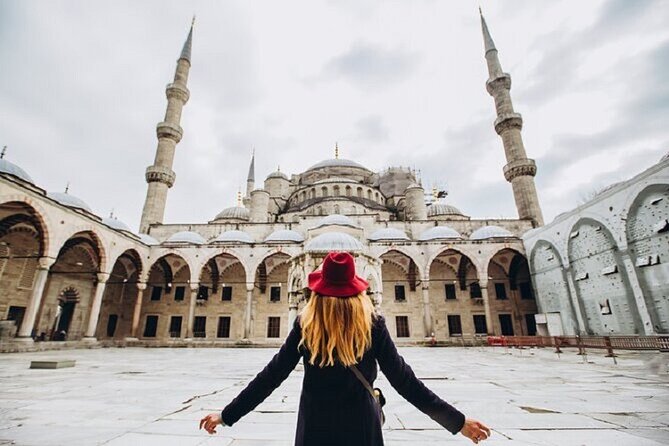
The Blue Mosque is directly across from Hagia Sophia. Built for Sultan Ahmet I and completed in 1617, it is known for its six minarets and thousands of blue İznik tiles. The interior is a functioning place of worship, so dress and behavior matter. Women need to cover their heads, shoulders, and knees. Men need to cover their knees if wearing shorts or bermuda shorts that come above the knee.
Head coverings and wraps are available at mosque entrances, but the supplied information notes that these may involve a charge. Carrying your own scarf is a simple way to avoid that extra cost.
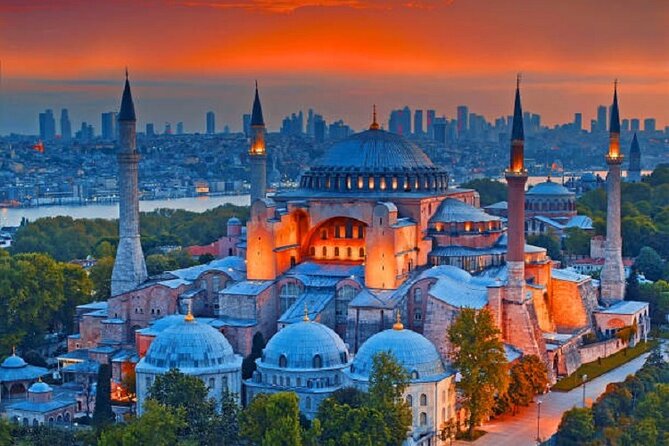
Hagia Sophia is one of Istanbul’s essential sights. The building has served as a Greek Orthodox cathedral, a mosque, and a museum before returning to mosque use. Its enormous dome, Byzantine mosaics, and Ottoman additions tell several chapters of the city’s past in one room.
Do not assume your guide can skip the line at Hagia Sophia. The guide does not have priority for the ticket and security queues, so waiting may take time. That is an important reason not to overload your day with too many additional stops.
Topkapı Palace and Basilica Cistern require choices
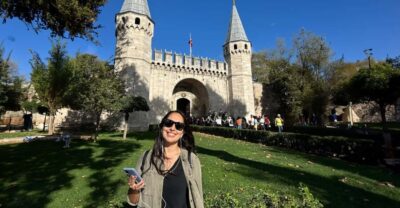
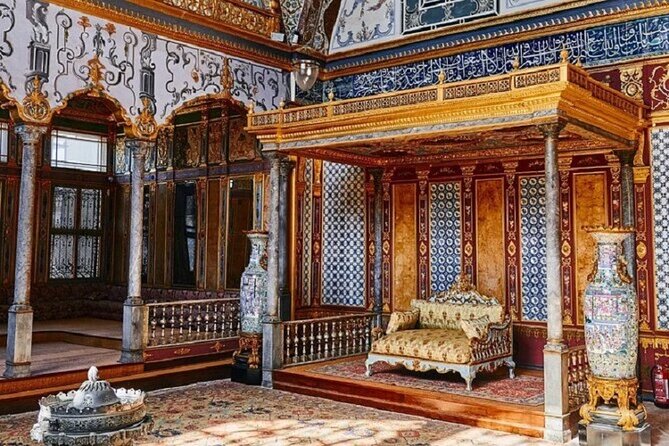
Topkapı Palace was the Ottoman administrative center and the home of the sultans for roughly four centuries. Its four courtyards offer a series of open-air spaces, palace buildings, and views toward the water.
The advertised stop allows 30 minutes, which is enough for an introduction but not a full palace visit. Admission is extra. If Ottoman court life interests you, make Topkapı a priority and tell your guide early. You may need to reduce the number of later stops.
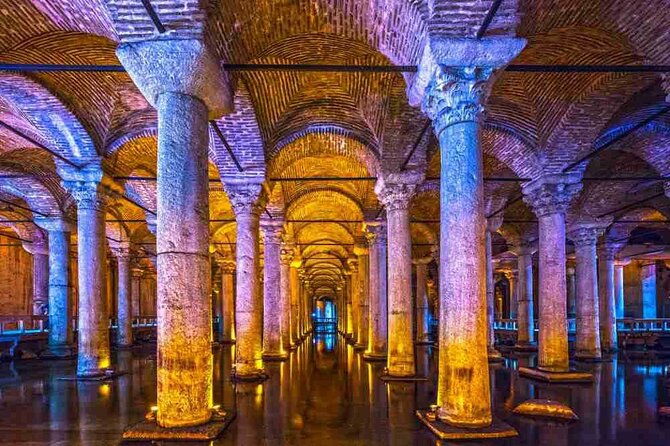
Basilica Cistern offers a very different mood. Below the streets, rows of columns support a vast underground water chamber that once held about 80,000 cubic meters of water. It is located west of Hagia Sophia and is the largest and best excavated of the city’s open cisterns.
The 30-minute visit gives you time to see the famous columns and unusual details, though admission is extra. The cistern has appeared in films, including From Russia with Love and Inferno, but its real value is the engineering and the strange sense of a city beneath the city.
Topkapı and the cistern are both worthwhile. I would not try to rush through them simply to claim more stops. Ask your guide to help you decide based on your interests.
Grand Bazaar and Spice Market show two sides of shopping
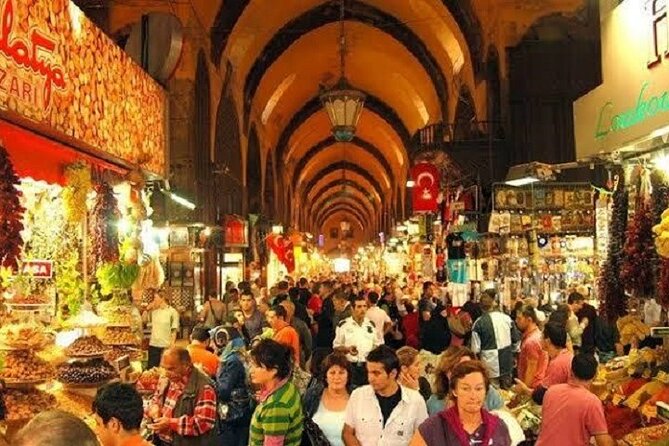
The Grand Bazaar dates to 1461, soon after the Ottoman conquest of Istanbul. Its covered lanes were organized by trade, and streets traditionally took names connected with the goods sold there.
The tour allows about 30 minutes. That is enough to get a feel for the old market atmosphere, but not enough for a relaxed shopping session if you want to compare carpets, jewelry, leather, ceramics, or other goods. Admission is free, though purchases are obviously not included.
The Spice Market, also called the Egyptian Bazaar, sits behind the New Mosque in Eminönü. Built in 1660 as part of the mosque complex, it originally relied on taxes from imported Egyptian goods. Spices still form a large part of the market, along with traditional food products and other merchandise.
I like these stops because they add daily commerce to a day otherwise filled with imperial buildings. Still, you should tell your guide if you want shopping time. A brief walk through the market and a serious buying session are two different plans.
The Grand Bazaar is closed Sundays. That detail matters if your tour falls at the end of the week.
Same base, a completely different sort of day:
- Istanbul: Bosphorus Dinner Cruise & Show with Private Table
★ 4.8 · 44,561 reviews - Istanbul: Daytime or Sunset Sightseeing Cruise & Audio Guide
★ 4.8 · 14,430 reviews - Istanbul: Bosphorus Dinner Cruise with Turkish Night Show
★ 4.8 · 10,127 reviews - Best of Istanbul 1, 2 or 3-Day Private Guided Istanbul Tour
★ 5.0 · 8,922 reviews
Dolmabahçe and Galata shift the city’s mood
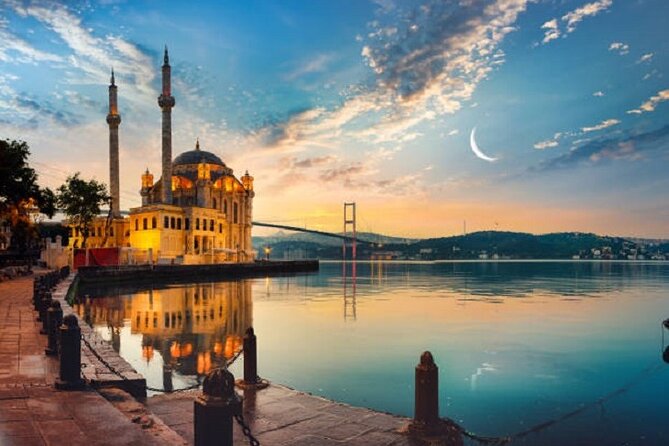
Dolmabahçe Palace sits along the Bosphorus in Beşiktaş. Built in the mid-19th century, it served as a residence for the last six Ottoman sultans at different times. Its Baroque, Rococo, and Neoclassical influences give it a more European appearance than Topkapı.
The planned stop lasts an hour, but admission is extra. This is another place where you should decide in advance if you want an interior visit or only an outside look. Dolmabahçe is closed Mondays, while Topkapı Palace is closed Tuesdays, so the day of the week should guide your choice.
Galata Tower dates from the 14th century and is the best-known surviving building from the Genoese colony in Istanbul. It rises near the entrance to the Golden Horn, surrounded by small streets, cafes, boutiques, and brick paving.
The tower ticket is not included. A 30-minute stop might allow an exterior look, or an interior visit if queues and timing cooperate. Ask clearly what is planned before paying for admission. The area around the tower is worth seeing even if you decide not to go up.
A Bosphorus view needs careful timing
The program lists a 30-minute Bosphorus cruise from the Bosphorus Bridge area. A boat ride is a fine way to see imperial palaces, old mansions, and buildings on both the European and Asian shores.
But the cruise is not included, and the wording does not specify the boat operator, departure time, or exact cruise length. Confirm those details with your guide before treating it as a central part of the day. A 30-minute listed stop may involve reaching the departure point rather than completing a long sightseeing cruise.
This is also where transport becomes important. The experience is described as a walking tour, and public transport may be used if needed, with fares paid by you. Istanbul’s districts are not all comfortably linked on foot within one day. A tram ride or other public transport can save time, but it also adds both cost and planning.
Fener, Balat, and the Golden Horn add local texture
Fener and Balat offer a change from the monumental center. Their sloping cobblestone lanes, colorful Ottoman houses, small workshops, cafes, churches, synagogues, and neighborhood life show a less formal side of Istanbul.
Fener was home to important Greek communities, while Balat has long connections with Jewish residents, including Sephardic Jews who settled there after exile from Spain in the 15th century. The area also includes churches and mosques, so you can see several religious traditions within a compact part of the city.
The Fener Greek Patriarchate and the Church of St. George share a courtyard. The patriarchate has remained in Istanbul for more than 17 centuries and continues to serve as the mother church for Orthodox Christians around the world. The Church of St. George has housed the Greek Orthodox Patriarchate since the 15th century.
The Bulgarian Orthodox Church of Saint Stephen is known as the Iron Church because it was built of iron and steel for the Bulgarian community during the final years of the Ottoman Empire. Its recent restoration has left the building in good condition, with a notable interior and icon wall.
The listed time for Fener and Balat is short, with 10 minutes at several individual stops. I would treat this part as a compact introduction unless you specifically ask for a slower neighborhood walk. The hills and uneven paving also make this one of the sections where comfortable shoes matter most.
The Golden Horn was once a trading harbor and residential area. Its shores reflect Istanbul’s mix of Greek, Armenian, Jewish, Romani, and Turkish communities. Pierre Loti Hill in Eyüp offers a different kind of pause, with a romantic setting linked to the French writer Julien Viaud, who used to write at a coffee house there.
Taksim and Istiklal show modern Istanbul
Taksim Square sits in the heart of modern Istanbul. Its name refers to the old distribution of water to different parts of the city. Today it connects commercial streets, public spaces, and Istiklal Avenue.
Istiklal Caddesi runs from Taksim toward the Karaköy area and is known for its historic tram. The tour gives only 10 minutes here, so you will get an orientation rather than a full walk through its shops and side streets.
I like including Taksim and Istiklal if you want to compare modern city life with the imperial quarter. I would not prioritize them over Topkapı, Hagia Sophia, or the Basilica Cistern on a first visit unless you have already seen the classic monuments.
What the guide quality means for your day
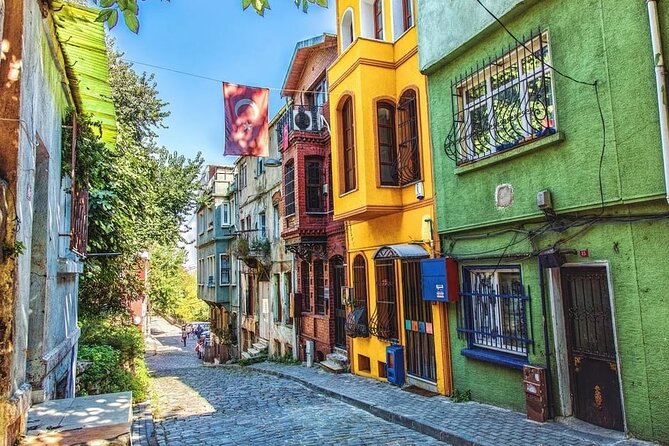
The strongest pattern in the feedback is guide flexibility and practical help. Kivanç received especially warm praise for adapting to requests, sharing useful information, and continuing to make the day work during heavy rain. Kaya was noted for clear communication and a flexible approach, while Huseyin was praised for moving efficiently from one place to the next.
Atilla was praised in one account for professionalism and customizing the route, but another account described inappropriate comments, impatience with photos, and a failure to visit much of the planned route. The operator responded that Atilla was no longer employed and explained that a city run and bicycle race had disrupted transport that day.
That serious complaint should not be ignored. It also shows why you should agree on priorities at the start, ask what is realistic, and speak up if the plan changes. A private tour works best when you and the guide set expectations clearly instead of treating the long stop list as a guarantee.
Pickup, timing, and extra costs
The standard meeting point is the German Fountain in Sultanahmet. If you stay at a centrally located hotel, the guide can meet you there on foot. Cruise ship passengers meet the guide on foot at the port gate.
A hotel outside the central area may require an extra pickup charge. If public transport is needed, you pay those fares. Cruise passengers must provide the ship name, docking time, disembarkation time, and re-boarding time at booking. That information helps the guide judge how much of the city is sensible to attempt.
The tour is private, so only your group participates. That is valuable for families, couples, and friends who want photo breaks or a slower pace. It also means the experience depends more heavily on the assigned guide and your own communication than a tightly managed group tour would.
Free cancellation is available up to 24 hours before the start time for a full refund. Changes inside that 24-hour window are not accepted, and a poor-weather or minimum-participant cancellation may result in another date or a full refund.
Who should book this Istanbul tour?
I would choose this experience if you want a private introduction, need hotel or port pickup, and prefer to shape the day around your own priorities. It is particularly useful for a first visit, a short cruise stop, or a small group that wants practical help with Istanbul’s layout.
I would be cautious if you want a slow, detailed visit inside every major monument. The $67 price is good for private guiding, but the paid admissions and possible transport costs add up. Most important, choose three or four priorities before you start.
For a first-time visit, I would suggest Sultanahmet with Hagia Sophia, the Blue Mosque, Topkapı Palace, Basilica Cistern, and either the Grand Bazaar or Spice Market. If you have already seen those places, use the private format for Dolmabahçe, Galata, Fener and Balat, or the Golden Horn.
Book it if flexibility, personal attention, and local orientation matter more to you than a fixed, fully ticketed package. Skip it if you want every cost settled in advance or dislike walking between districts. The tour can be excellent with a strong guide and a realistic plan, but the enormous stop list needs editing before the day begins.
FAQ
How long does the private Istanbul tour last?
The experience lasts approximately seven to eight hours.
Where does the tour start?
The standard meeting point is the German Fountain in Sultanahmet. A guide can meet you on foot at a centrally located hotel, or at the cruise port gate if you arrive by ship.
Is transportation included?
No. The tour is primarily a walking tour. If public transportation is needed, you pay the fares. An extra pickup charge may apply for hotels outside the central area.
Are entrance fees included?
No. Admission fees for museums and paid sights are separate. This includes places such as Topkapı Palace, Hagia Sophia, Basilica Cistern, Dolmabahçe Palace, Galata Tower, and the Bosphorus cruise.
Can the itinerary be customized?
Yes. The private format allows you to request the Istanbul sights and interests you want to cover. The long list of possible stops means you should agree on priorities with your guide.
Is Hagia Sophia skip-the-line access included?
No. Guides do not have skip-the-line priority at Hagia Sophia, so you may need to wait in the ticket and security lines.
Which sights are closed on certain days?
Dolmabahçe Palace is closed Mondays, Topkapı Palace is closed Tuesdays, and the Grand Bazaar is closed Sundays.
What should I wear when visiting mosques?
Women need to cover their heads, shoulders, and knees. Men need to cover their knees when wearing shorts or bermuda shorts above the knee. Scarves and wraps are available at mosque entrances, sometimes for a charge.
Just added around Istanbul
- istanbul airport transfer★ 3.5 · 43 reviews
- Istanbul Private Guiding Service★ 5.0 · 68 reviews
- Flying Dress Photography on an Iconic Rooftop in Istanbul★ 5.0 · 87 reviews
- Food Tour in Istanbul with Local Guide★ 5.0 · 37 reviews
- Best Istanbul tour with private guide by skipping ticket line★ 5.0 · 103 reviews
- istanbul old city private tour★ 5.0 · 19 reviews
- Istanbul Private Tour (Licensed Guide)★ 5.0 · 17 reviews
- Istanbul Airport (IST) To Hotels Transfer★ 5.0 · 80 reviews
Istanbul Tours, compared.
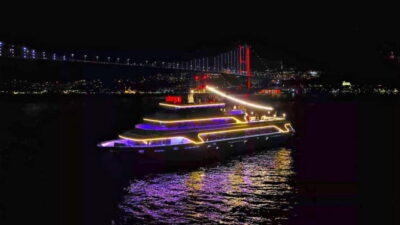
Bosphorus Dinner Cruise & Show with Private Table
Read our review →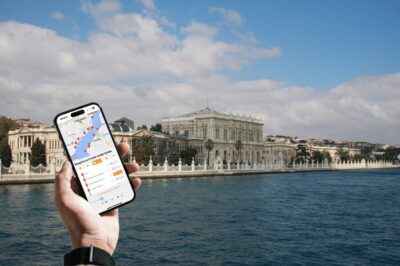
Daytime or Sunset Sightseeing Cruise & Audio Guide
Read our review →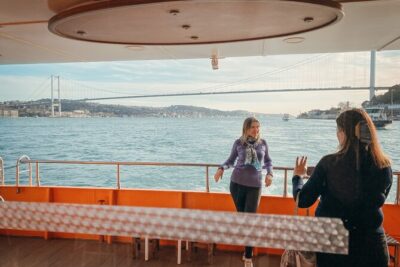
Bosphorus Dinner Cruise with Turkish Night Show
Read our review →
Best of Istanbul 1, 2 or 3-Day Private Guided Istanbul Tour
Read our review →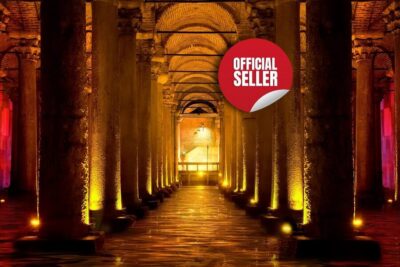
Basilica Cistern Fast-Track Entry and Audio Guide
Read our review →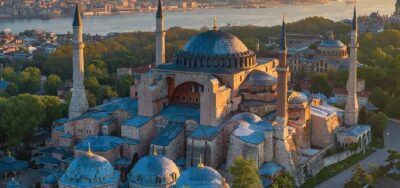
Hagia Sophia Skip-the-Line Ticket & Museum Option
Read our review →
Hodjapasha Whirling Dervishes Show & Exhibition
Read our review →