
Reviewed · ISTANBUL TOURS
Istanbul Private Tours: 1, 2 or 3 Day Highlights
Istanbul’s big story unfolds across a compact old-city area, and this private tour puts a guide beside you as you move from the Roman Hippodrome to Ottoman mosques, underground Byzantine chambers, busy markets, and the Bosphorus. You can fit the main sights into a half or full day, or spread them across three days at a calmer pace.
I like the private format, since your guide can adjust the route to your interests and available time. I also like the human touch reported by guests who worked with Ozgur and Ali, both praised for clear explanations, friendly care, and adapting the day to their needs.
The main consideration is cost at $200 per group, before admission fees, lunch, and transport. That can be strong value for a group of several people, but less so for one or two visitors, especially if you add a vehicle and several paid sights.
Key points to know before booking
- Choose one, two, or three days: The format can cover Istanbul’s main sights in roughly 6 to 20 hours, so you can match the tour to your schedule.
- Private guiding makes a difference: Your guide can slow down at Hagia Sophia, skip a less important stop, or shape the day around architecture, religion, shopping, or local neighborhoods.
- The old city is largely walked: Sultanahmet’s major sights sit close together, but comfortable shoes matter. Public transport may be needed for farther stops.
- Several entrance fees are extra: Hagia Sophia, the Basilica Cistern, the Bosphorus boat, and Dolmabahçe Palace are not included.
- Friday and holiday planning matters: The Blue Mosque has limited access on Friday mornings, and several markets close on major religious holidays.
- The vehicle upgrade is most useful outside Sultanahmet: If your hotel is in the old city, you do not need to choose the vehicle option.
A flexible way to see Istanbul in one to three days
The tour begins with a licensed local guide meeting you in your hotel lobby if you stay in central Istanbul or near Galata Port. For hotels outside the central area, the meeting point is Sura Design Hotel in Sultanahmet.
The advertised price is $200 per group, with the main tour description listing up to five people. The additional details describe private groups of up to eight, so confirm the exact group limit and vehicle price before paying. For a family or group of friends, the flat rate may work well. For a solo visitor, it is a much bigger expense.
The one-day plan is ambitious. The listed stops add up to many hours even before lunch, queues, prayer breaks, and transport. A half-day version can focus on Sultanahmet, while two or three days give you time for the Bosphorus, Dolmabahçe, Fener and Balat, and the markets without turning the day into a march.
The strongest feature is flexibility. If Hagia Sophia is your priority, your guide can spend more time there. If you prefer daily life and shopping, you can give extra attention to the Grand Bazaar, Spice Market, and neighborhood streets.
A few more Istanbul half-days to weigh up
- Best of Istanbul 1, 2 or 3-Day Private Guided Istanbul Tour
★ 5.0 · 8,922 reviews - Best Of Istanbul: 1, 2 or 3 Day Private Guided Tour
★ 5.0 · 435 reviews - Full Day Istanbul 1, 2 or 3-Day Private City Guided Tour
★ 4.7 · 411 reviews
The Roman Hippodrome and Sultanahmet’s three great sights
The Hippodrome is a good starting point because it explains why this part of Istanbul matters. This was once Constantinople’s chariot-racing arena and a public meeting place at the center of Roman and Byzantine life.
You will see the Obelisk of Theodosius, brought from Egypt in the fourth century, along with the Serpent Column and the German Fountain. There is no admission fee, and the stop takes about 30 minutes. I like this opening because the monuments give you physical clues before you enter the larger buildings.
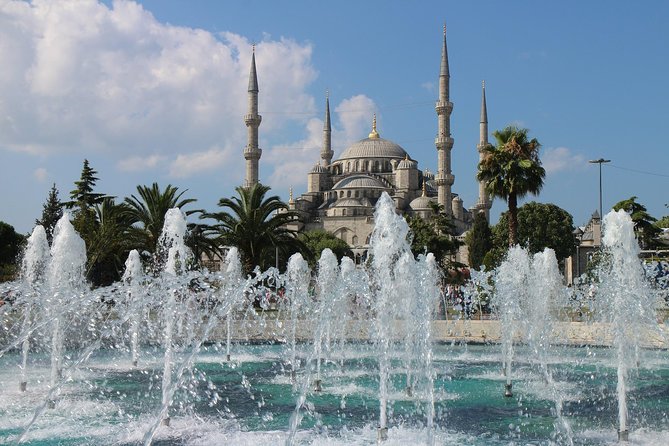
The Blue Mosque follows. Officially the Sultan Ahmed Mosque, it is known for the blue Iznik tiles inside, along with stained glass, calligraphy, and a broad prayer hall. The planned visit lasts about 45 minutes and is free.
Remember that this is an active place of worship. Modest clothing is required, shoes come off inside, and visiting hours can change around prayer. On Fridays, the mosque is closed until roughly 2:00 or 2:30 p.m. for the sermon, with only an outside visit possible earlier in the day.
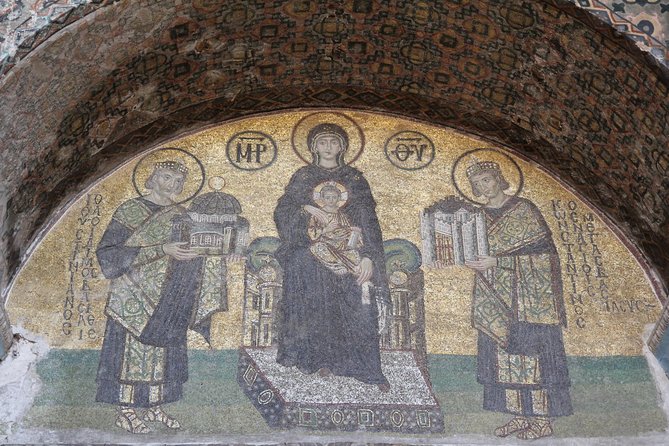
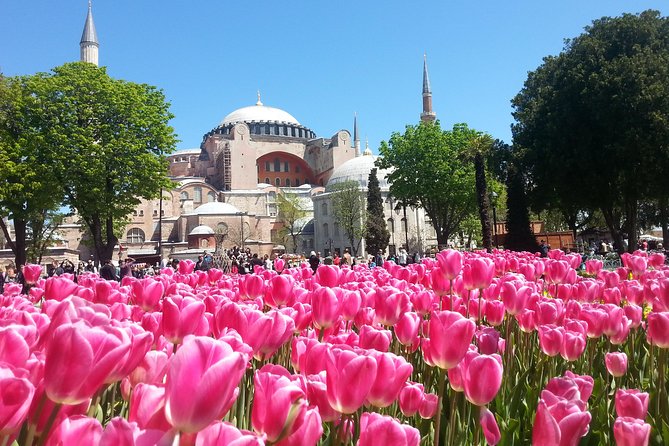
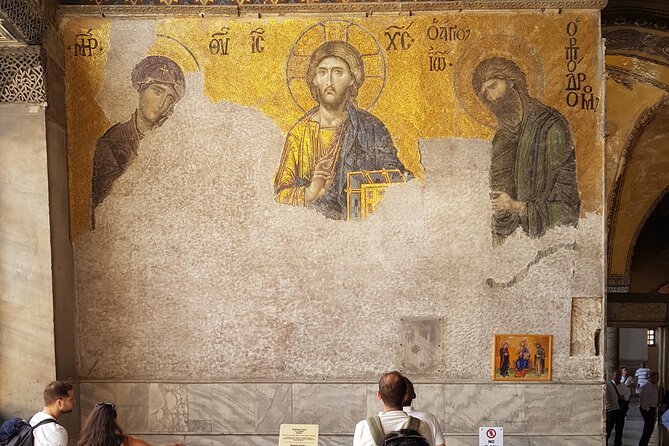
Hagia Sophia is the major architectural stop. Built in the sixth century as a Christian cathedral, it later became a mosque and is now presented as a mosque with its historic art and architecture on view. Its dome, mosaics, calligraphy, and long religious story make it one of the most important stops in Istanbul.
Allow about an hour, but note that admission is not included. Prayer times can also limit access. One especially useful detail from the guiding experience is the attention given to the upper gallery, where you may see remarkable glass mosaics that are easy to miss when you rush through the main floor.
Caferağa Medresesi and the Basilica Cistern
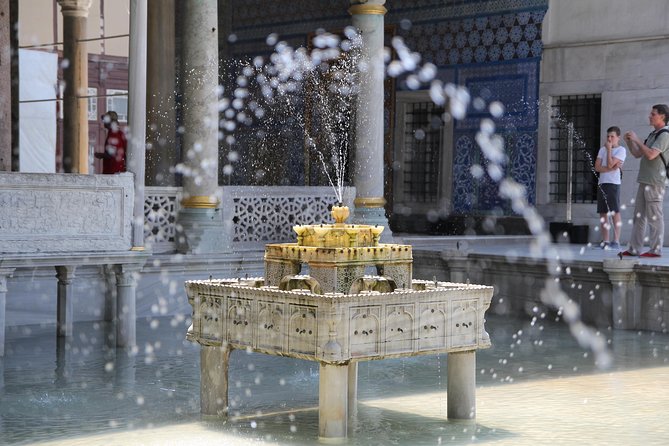
Caferağa Medresesi is a short ten-minute stop, but it adds a different note to the morning. Designed by Ottoman architect Mimar Sinan, the former religious school now contains exhibition rooms featuring Turkish art and music.
You should not expect a major museum visit here. It is a compact look at Ottoman educational architecture and current artistic work, useful as a pause between larger monuments.
The Basilica Cistern is far more atmospheric. You descend underground into a sixth-century reservoir built during Emperor Justinian’s reign. Rows of marble columns rise above shallow water, and raised walkways lead through the dim interior.
The famous Medusa heads are the visual payoff, but the real pleasure is the change of mood. After the open squares and crowded streets above, the cistern feels quiet and strange. Admission is extra, and the suggested visit is about an hour.
This is one place where a private guide can add real value. The structure can seem like a forest of columns without context. A guide can explain its purpose, construction, and place in Byzantine Constantinople before you move on.
Grand Bazaar and Spice Market shopping time
The Grand Bazaar is one of Istanbul’s essential stops, but 45 minutes is enough only for a first look. Its covered lanes contain thousands of shops selling textiles, ceramics, jewelry, spices, and other Turkish goods.
You will get the most from the bazaar if you treat it as a cultural stop first and a shopping stop second. The setting is historic, but the sales process can be intense. If you want to buy something, ask your guide for help with orientation and realistic expectations.
The bazaar is closed on Sundays. It also closes during the listed Ramadan holiday period, Eid al-Adha, and Republic Day, so check the date before building your day around it.
The Spice Market, or Egyptian Bazaar, is smaller and more focused. Expect about 30 minutes among stalls selling saffron, cinnamon, sumac, dried fruit, nuts, teas, Turkish delight, and other food items.
I prefer the Spice Market for a quick sensory introduction to Istanbul. The colors and smells arrive immediately, and the building is easier to handle than the Grand Bazaar. Still, both markets can feel commercial, so use the time to see how the city trades as well as to shop.
Same base, a completely different sort of day:
- Istanbul: Bosphorus Dinner Cruise & Show with Private Table
★ 4.8 · 44,561 reviews - Istanbul: Daytime or Sunset Sightseeing Cruise & Audio Guide
★ 4.8 · 14,430 reviews - Istanbul: Bosphorus Dinner Cruise with Turkish Night Show
★ 4.8 · 10,127 reviews - Istanbul: Basilica Cistern Fast-Track Entry and Audio Guide
★ 4.6 · 7,521 reviews
A two-hour Bosphorus boat trip between Europe and Asia
The Bosphorus cruise is one of the best reasons to choose the longer version of this experience. The public boat route gives you a new view of Istanbul, with water between the European and Asian shores and major landmarks along the way.
You may pass Dolmabahçe Palace, Ortaköy Mosque, and Rumeli Fortress. The ride includes seating and open-air decks, and the planned duration is about two hours. The boat ticket is extra.
This is not a private yacht outing. You are using a public boat, which keeps the cost more reasonable but means the schedule and onboard setting are shared with other passengers. For most visitors, that is a fair trade. The Bosphorus is best appreciated from the water, and this option gives you the view without paying for a private cruise.
Bring a layer for the open deck and allow time for the boat schedule. The cruise is also a useful break after several hours of walking through stone courtyards and museum halls.
Taksim, Istiklal, Galata, and the Golden Horn
The tour then shifts from imperial Istanbul to modern Beyoğlu. Taksim Square is the main transport hub and a symbol of present-day Istanbul. The planned stop lasts about an hour, though the square itself is more useful as a starting point than as a sightseeing destination.
Istiklal Caddesi is the pedestrian boulevard leading through the district. Its buildings hold shops, cinemas, cafes, bars, antique stores, and rooftop restaurants. Allow about 45 minutes, with extra time if you want to stop for food or browse side streets.
Galata Tower receives only an outside visit of about ten minutes. The tower dates from 1348 and has served as a defensive structure, prison, and lookout. If you want to go inside, ask about tickets and timing, since the listed tour does not include an interior visit.
Galata Bridge crosses the Golden Horn and gets another brief ten-minute stop. It is more of a viewpoint and transition than a full attraction. You might see fishermen along the bridge and boats moving below, but the value comes mainly from connecting the old city with Beyoğlu.
Dolmabahçe Palace and Sinan’s Ottoman mosques
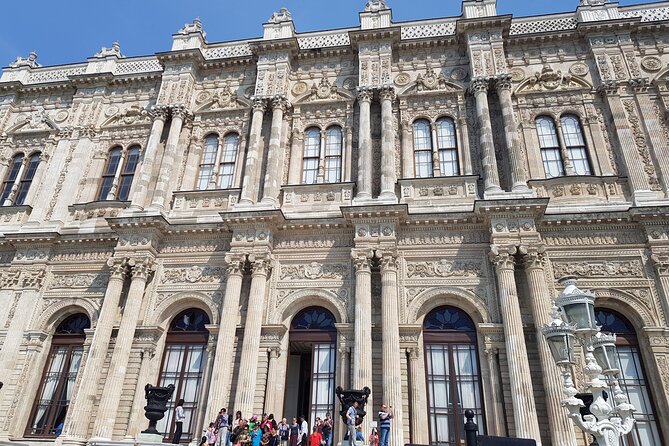
Dolmabahçe Palace sits beside the Bosphorus and represents a later, more European-facing Ottoman style. Built in the mid-19th century, it served as a royal residence until the sultanate ended in 1922.
The visit lasts about an hour, and admission is extra. This is a good choice if you want to compare the palace’s later imperial taste with the more restrained religious architecture of the older mosques.
Süleymaniye Mosque offers a different kind of grandeur. Commissioned by Sultan Suleiman the Magnificent and designed by Mimar Sinan, it occupies one of Istanbul’s hills, with a large dome, minarets, courtyards, tilework, calligraphy, and stained glass.
The planned visit is 45 minutes and free. The hilltop setting gives the mosque room to breathe, and the courtyards provide a quieter pause than Sultanahmet’s main square. As with the Blue Mosque, it remains a place of worship, so dress and prayer schedules matter.
Rüstem Pasha Mosque is smaller and more intimate. Sinan designed it in the 16th century, and the interior is known for its Iznik tiles with floral and geometric designs.
Set among the streets of Eminönü, it can be easy to miss without a guide. Allow an hour. I consider it one of the most rewarding architectural stops because the tilework is the main event, and the smaller scale lets you examine it without the huge volume of Hagia Sophia or the Blue Mosque.
The city walls, Fener, Balat, and the Greek Patriarchate
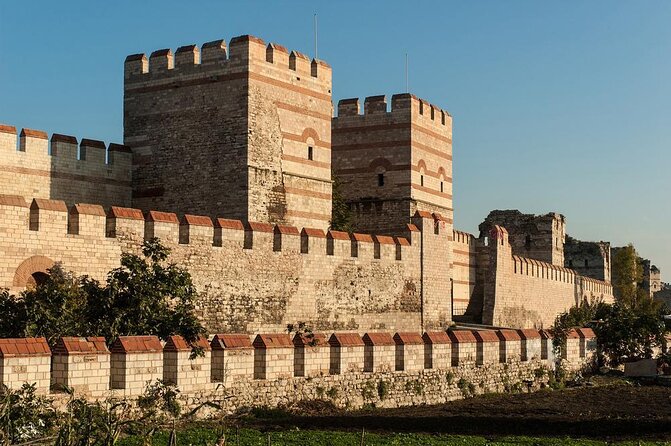
The Walls of Constantinople show how seriously the Byzantine emperors took defense. Built in the fifth century under Theodosius II and later strengthened under Leo I, the walls once protected the landward side of the city.
The stop lasts about 20 minutes and is free. It is brief, but it adds military context to the churches, palaces, and markets you see elsewhere.
Fener and Balat require more time, about two hours. The neighborhoods sit along the Golden Horn and contain colorful houses, narrow lanes, cafes, small shops, and historic religious sites.
This is the part of the tour that feels less like a checklist. You see old residential streets and the remains of Istanbul’s Greek, Jewish, Armenian, and Ottoman communities. The Church of St. George, the Greek Orthodox Patriarchate, and the Fener Greek High School help explain that mixed past.
The Fener Rum Patriarchate, also called the Church of St. George, receives a separate 45-minute stop. It is a major Eastern Orthodox church and the seat of the Ecumenical Patriarchate in Istanbul.
Fener and Balat are best saved for a longer tour day. Their value comes from walking slowly, looking at details, and letting your guide explain what changed in these neighborhoods over time. They are not as tightly packed with headline sights as Sultanahmet, but they give you a better sense of the city beyond the main monuments.
What the $200 price really covers
The price includes a licensed professional guide and hotel pickup in central areas. It does not include lunch, admission fees, public transportation, or personal purchases.
That separation matters. If you visit Hagia Sophia, the Basilica Cistern, Dolmabahçe Palace, and take the Bosphorus boat, your final cost will be higher than the advertised group price. The vehicle upgrade adds convenience, but it may not be necessary if your hotel is in Sultanahmet, since the main old-city sights are close enough to walk.
For five people, $200 works out to $40 each before extras. For eight, if that group size is confirmed, the per-person price is lower. For one person, you are paying mainly for privacy and tailored guiding rather than a bargain.
The tour is generally booked well ahead, with an average booking lead time of 39 days. In April through October, early booking makes sense because private guides fill quickly.
Free cancellation is available up to 24 hours before the start time. Changes or cancellations inside that window are not refunded.
Who should book this Istanbul tour
I would consider this tour for a first visit when you want the major sights explained rather than simply photographed. It suits families, friends, and couples who value a private guide and can split the group price.
It is also useful if you have only four or five hours. One guest used the shorter format to see Sultanahmet’s main sights and still had time for other parts of Istanbul. That is a sensible way to use the tour: get the difficult historical orientation first, then explore alone.
The tour is less appealing if you prefer a slow, independent pace or already know Istanbul well. You will need to budget for several admissions, and the one-day version may feel rushed if you attempt every stop.
The strongest praise centers on the guides. Ozgur was noted for explaining Turkish history and culture while adjusting the route to personal needs. Ali was described as friendly, well informed, and attentive from start to finish. Those qualities matter here because Istanbul’s monuments can blur together without a clear story.
Should you book it?
Book this tour if you want a private introduction to Istanbul, especially for a first visit or a short stay. Choose the half-day option for Sultanahmet, two days for the main monuments plus the Bosphorus, and three days if Fener and Balat, Dolmabahçe, and modern Beyoğlu matter to you.
Before booking, confirm the group limit, vehicle supplement, entrance costs, and which sites can be visited inside on your date. With that planning, the tour offers a practical blend of famous landmarks, Ottoman architecture, Byzantine remains, markets, and ordinary city streets.
FAQ
How long does the Istanbul private tour last?
The available formats last approximately 6 to 20 hours, depending on whether you choose one, two, or three days.
How many people can join the private tour?
The price is listed for a group of up to five people. Additional details describe private groups of up to eight, so confirm the exact limit when booking.
Is hotel pickup included?
A guide meets you at your hotel if it is in the city center or near Galata Port. If your hotel is outside those areas, the meeting point is Sura Design Hotel in the old city.
Is transportation included?
Public transportation is not included. A private vehicle upgrade is available, and guests staying in Sultanahmet generally do not need the vehicle option.
Are entrance fees included?
No. Admission fees for the listed sites and museums are extra, including Hagia Sophia, the Basilica Cistern, the Bosphorus boat, and Dolmabahçe Palace.
Is lunch included?
No. Lunch and personal expenses are not included in the tour price.
Is the Grand Bazaar open every day?
The Grand Bazaar is closed on Sundays. It also closes during the listed Ramadan holiday period, Eid al-Adha, and Republic Day.
Can I visit the Blue Mosque on a Friday?
The Blue Mosque is closed until approximately 2:00 or 2:30 p.m. on Fridays for the sermon. Before then, the tour provides an outside visit only.
Is Hagia Sophia always open during the tour?
Hagia Sophia may be closed during prayer times. Your guide can account for the schedule, but access inside is not guaranteed at every hour.
Can I cancel for a full refund?
You can cancel up to 24 hours before the experience begins for a full refund. Cancellations or changes made less than 24 hours before the start time are not refunded.
Just added around Istanbul
- istanbul airport transfer★ 3.5 · 43 reviews
- Istanbul Private Guiding Service★ 5.0 · 68 reviews
- Flying Dress Photography on an Iconic Rooftop in Istanbul★ 5.0 · 87 reviews
- Best Istanbul tour with private guide by skipping ticket line★ 5.0 · 103 reviews
- Food Tour in Istanbul with Local Guide★ 5.0 · 37 reviews
- istanbul old city private tour★ 5.0 · 19 reviews
- Istanbul Private Tour (Licensed Guide)★ 5.0 · 17 reviews
- Istanbul Airport (IST) To Hotels Transfer★ 5.0 · 80 reviews
Istanbul Tours, compared.
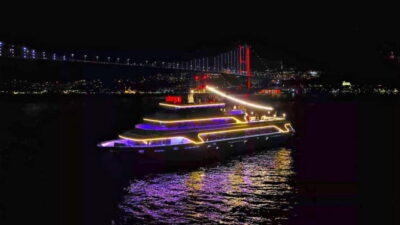
Bosphorus Dinner Cruise & Show with Private Table
Read our review →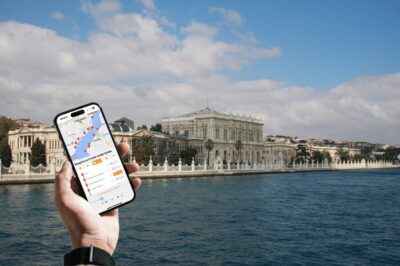
Daytime or Sunset Sightseeing Cruise & Audio Guide
Read our review →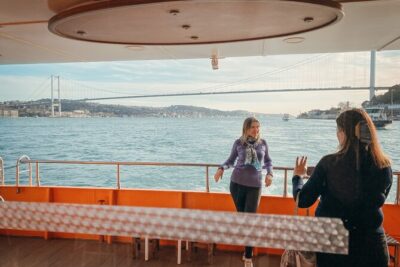
Bosphorus Dinner Cruise with Turkish Night Show
Read our review →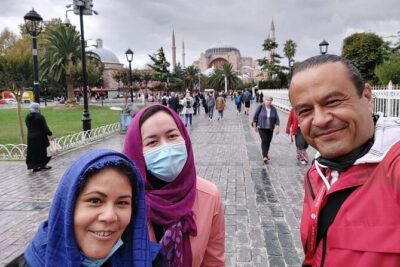
Best of Istanbul 1, 2 or 3-Day Private Guided Istanbul Tour
Read our review →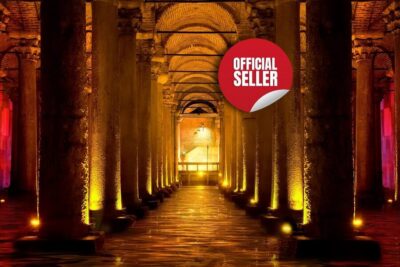
Basilica Cistern Fast-Track Entry and Audio Guide
Read our review →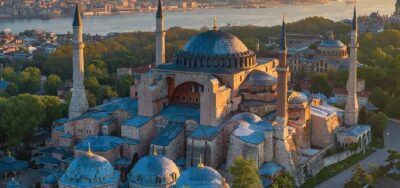
Hagia Sophia Skip-the-Line Ticket & Museum Option
Read our review →
Hodjapasha Whirling Dervishes Show & Exhibition
Read our review →
Topkapi Palace & Harem Museum Ticket & Audio Guide
Read our review →Browse the lists this tour appears in