
Reviewed · ISTANBUL TOURS
Istanbul: Top Museums Guided Pass
Istanbul’s grandest sights sit close together in Sultanahmet, but their stories span Roman emperors, Byzantine worship, Ottoman sultans, and modern Turkey. This guided pass brings Hagia Sophia, Topkapi Palace, Basilica Cistern, the Blue Mosque, Hippodrome Square, and Grand Bazaar into one organized visit, with an English-speaking guide to connect the pieces.
I like the practical route and the strong historical focus. I also like that your pass remains valid for three days, so you are not forced to cram every stop into one session. The main catch is the price, $171 per person, and there is no skip-the-line service at Hagia Sophia or the Blue Mosque. In busy months, security checks can take about 45 minutes.
Key points to know before booking
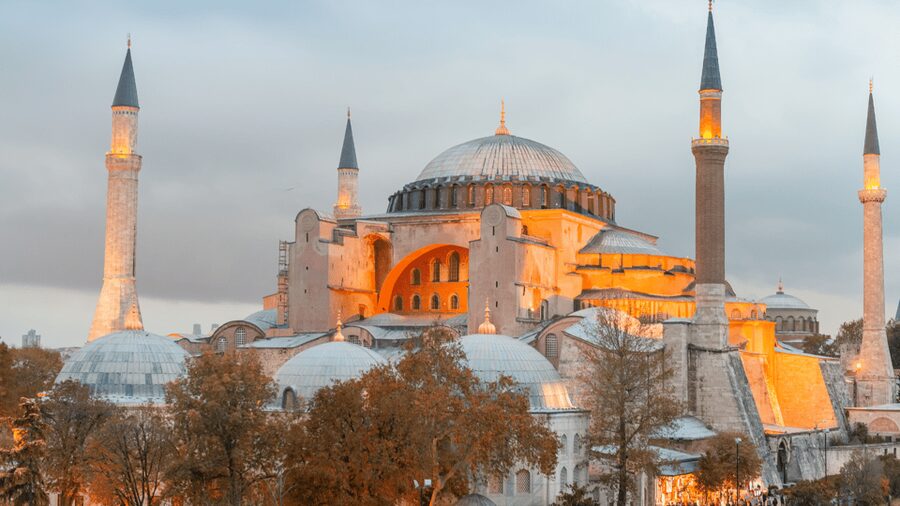
- Hagia Sophia gives the tour its biggest historical punch: A single building has served as a Christian cathedral, an imperial mosque, and a major religious center for roughly 1,500 years.
- Topkapi Palace is the largest stop: Its courtyards, treasury, kitchens, gardens, audience spaces, and kiosks need more attention than a quick photo visit.
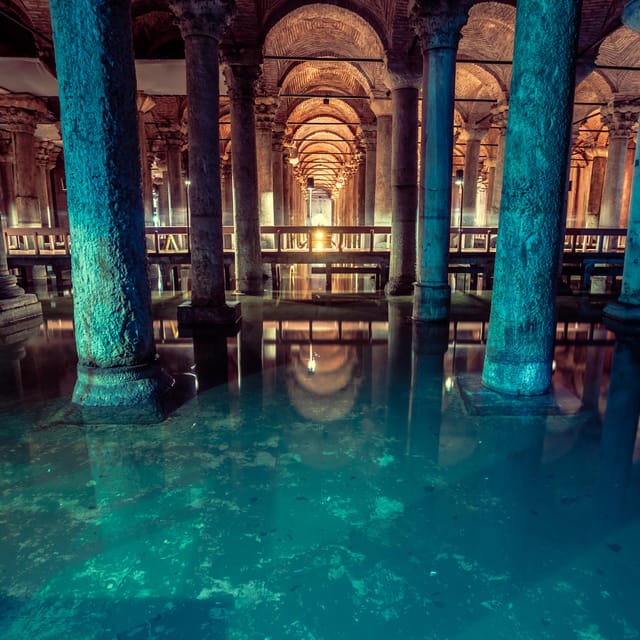
- The Basilica Cistern is atmospheric and unusual: You walk beneath the city among 336 columns, including two famous Medusa heads.
- The Blue Mosque is still a working place of worship: Dress modestly, carry a headscarf if needed, and expect possible security delays.
- The pass is flexible: It is valid for three days, and you can join a preferred tour time shown on the timetable.
- Guiding is the main value: Can, Ahmet, Dilek, Ihsan, and other guides have been praised for clear English, patience, humor, and strong storytelling.
Why this route works in Sultanahmet
The tour begins at the BUSFORUS Istanbul hop-on hop-off tour point, then moves on foot through the old city. That matters because these sights are not scattered across Istanbul. Hagia Sophia, the Blue Mosque, the Basilica Cistern, Hippodrome Square, and Topkapi Palace all sit within the historic core.
You are not simply ticking off unrelated attractions. The route lets you see how one imperial center changed hands and faiths over many centuries. Roman public life, Byzantine Christianity, Ottoman rule, and the modern tourist district all overlap within a short walk.
The advertised guided visit lasts about 2.5 to 3 hours. That is enough for a clear introduction, but not enough for a slow, room-by-room study of every palace collection. If you like to read every label and linger over small details, plan to return using the three-day validity of the pass.
The guide is the key part of the experience. Several guides have received especially strong praise for their storytelling and patience, including Can, Ahmet, Dilek, Ihsan, Adam, Deniz, and Onur. The most useful quality is not simply knowing dates. It is the ability to explain why a building mattered and how its role changed.
More museums and galleries in Hagia Sophia:
- Istanbul: Hagia Sophia Skip-the-Line Ticket & Museum Option
★ 3.7 · 4,958 reviews - Istanbul: Hagia Sophia Mosque and Museum Skip-The-Line Combo
★ 4.5 · 136 reviews - Istanbul: Hodjapasha Whirling Dervishes Show & Exhibition
★ 4.4 · 4,790 reviews
Hagia Sophia, where two religious traditions share one building
Hagia Sophia is the emotional center of the tour. It was built in only five years and completed in the sixth century under the Byzantine Emperor Justinian. Its dome rises about 55.60 meters, with a diameter of roughly 31.87 meters. For around 800 years, it was the largest dome in the world.
That scale is impressive, but the more interesting point is the building’s changing role. Hagia Sophia served as the headquarters of Orthodox Christianity and as the coronation place for Roman emperors. It later became the first mosque in Istanbul after the Ottoman conquest. The building’s Christian and Islamic elements share the same interior, giving your guide plenty to explain.
Look for the way religious images and architectural features exist side by side. The building is not a tidy museum display. It reflects layers of use, adaptation, and political change. That makes a guide particularly helpful here, since an unsupported walk through the vast interior can leave you noticing only the dome.
You should allow extra time for security. This pass does not promise a skip-the-line entrance at Hagia Sophia. During peak periods, the security wait may reach about 45 minutes. The guide remains with the group and fills the wait with stories about Hagia Sophia and the Blue Mosque, but you still need to budget for standing in line.
The Blue Mosque and the meaning of Sultanahmet
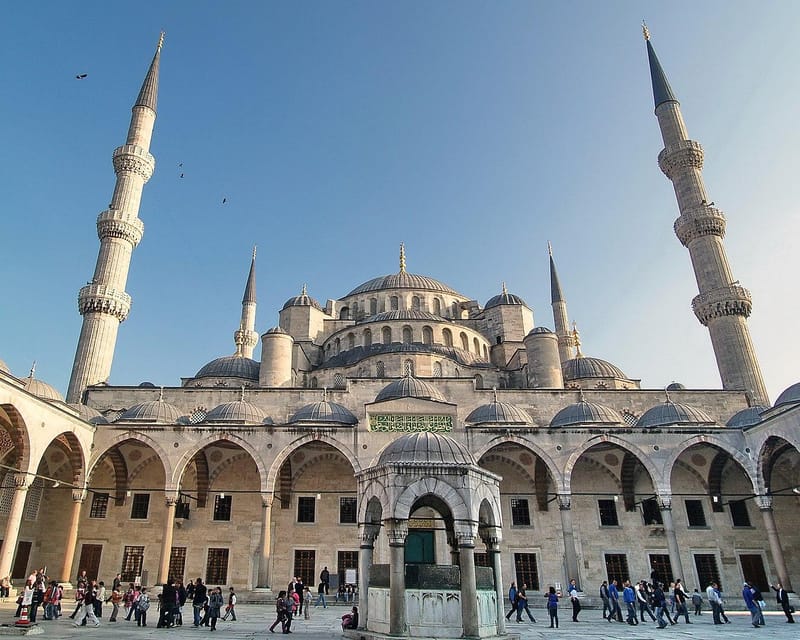
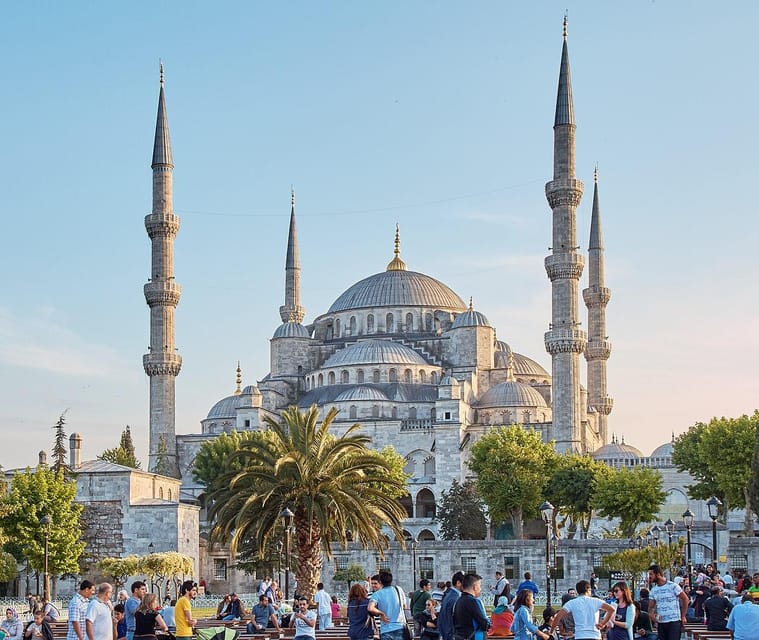
The Blue Mosque is officially the Sultanahmet Mosque, named after Sultan Ahmed I, who commissioned it. The district also carries the name Sultanahmet, which can cause confusion. In this corner of Istanbul, Sultanahmet can refer to the mosque, the sultan, or the surrounding area.
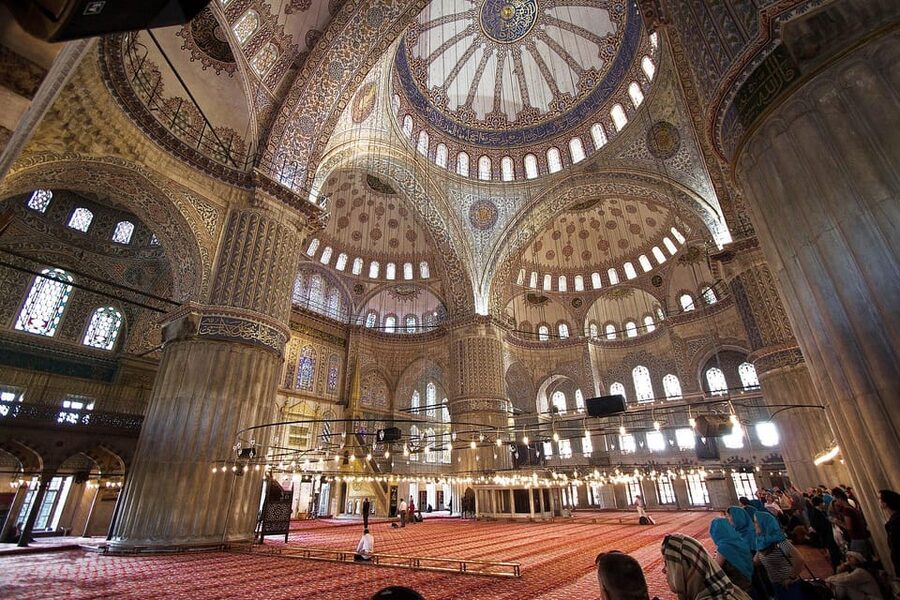
The nickname Blue Mosque comes from the thousands of blue Iznik tiles used in the interior. Iznik was Turkey’s leading tile-producing center, and the tiles give the mosque its familiar color and pattern. Your guide can also explain the Ottoman practice of naming mosques after the person who ordered and paid for construction.
This remains a mosque rather than a silent museum. Visitors need to dress respectfully, and women should bring a headscarf. Shorts and short skirts are not allowed. Worship schedules and security checks can affect the timing, so keep your plans flexible.
The same line issue applies here. There is no skip-the-line service at the Blue Mosque, and a 45-minute security wait is possible in peak season. That makes the guide’s commentary useful, but it also means the tour may feel longer than the headline duration.
The Blue Mosque is best appreciated as both a work of art and a functioning religious building. You get a better sense of it when you pay attention to the courtyard, the scale of the prayer space, the tile patterns, and the relationship between the mosque and the square outside.
Basilica Cistern, Istanbul’s underground water world
The Basilica Cistern changes the mood completely. After the open spaces of Sultanahmet Square and the lofty interiors of the mosques, you descend into a shadowy underground chamber supported by 336 columns.
The columns are about nine meters long, and two famous Medusa heads add a touch of mystery. Their placement has inspired plenty of theories and stories. Your guide can explain the cistern’s practical purpose as a water reservoir while pointing out the details that are easy to miss on your own.
This is one of the most visually distinctive stops on the route. The repeated columns, dim light, and underground setting make it feel unlike the other monuments. It is also a relatively compact visit, which helps the tour maintain its pace.
The guided entrance ticket is included. You walk through the cistern with the guide rather than receiving only an admission ticket and a map. That difference matters because the building’s engineering is less obvious than its atmosphere. Without explanation, you may admire the columns without understanding how the cistern fitted into the city’s water supply.
Wear comfortable shoes for the full route. The tour includes several walking sections, and the old city’s historic sights are experienced on foot rather than from a private vehicle.
A few more Hagia Sophia half-days to weigh up
- Istanbul: Blue Mosque & Hagia Sophia Guided Tour w/ Tickets
★ 4.8 · 3,600 reviews - Istanbul: Hagia Sophia Skip-the-Line Ticket and Audio Guide
★ 4.3 · 2,246 reviews - Istanbul: Basilica Cistern & Hagia Sophia Combo Ticket
★ 4.6 · 1,990 reviews - Istanbul: Blue Mosque, Hagia Sophia, & Basilica Cistern Tour
★ 4.7 · 1,806 reviews
Topkapi Palace, the Ottoman center of power
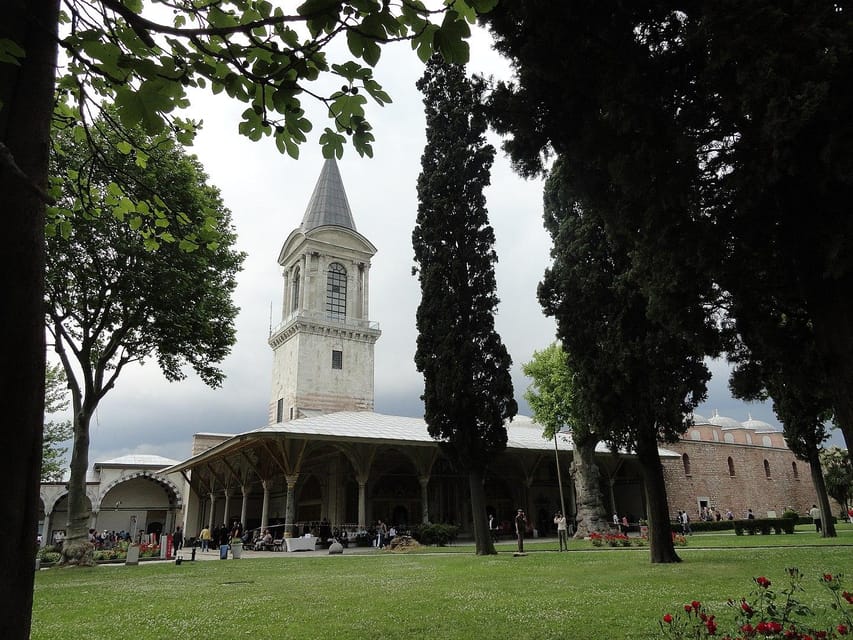
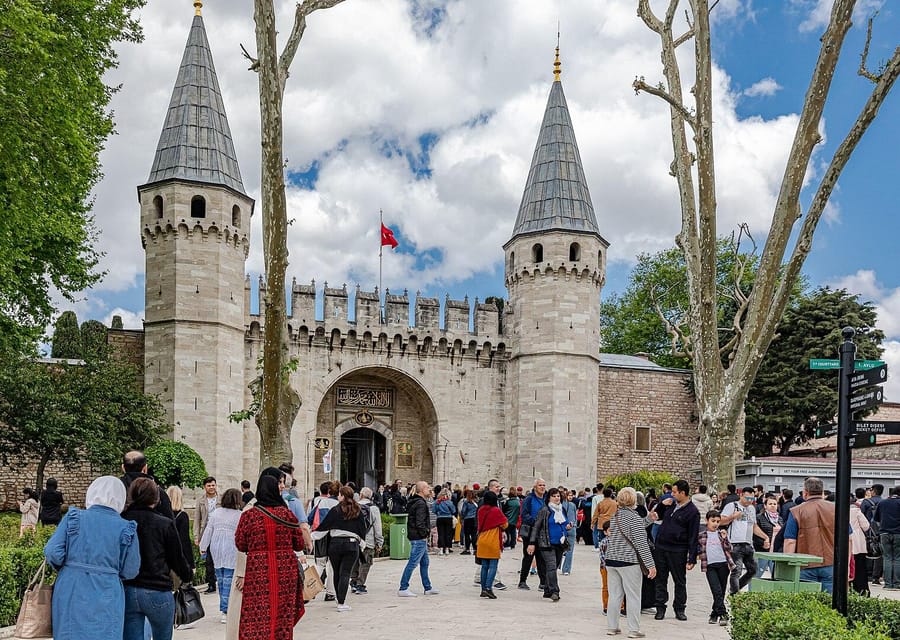
Topkapi Palace is the largest and most demanding stop. It was the main palace of the Ottoman sultans and is often described as Turkey’s most important museum. The complex is arranged through first, second, third, and fourth courtyards, with spaces that once handled government, ceremony, domestic life, and imperial display.
The route can include the Audience Hall, the Divan or High Court, historic kitchens, royal stables, treasury, gardens, and kiosks. Each courtyard marks a shift in access and function. The farther into the palace you go, the closer you get to the private and ceremonial heart of Ottoman rule.
I like Topkapi because it gives you a working picture of an empire rather than a single grand room. The kitchens show the scale of palace life. The treasury reflects imperial wealth. The audience spaces reveal the formal distance between the sultan and everyone else.
The guide’s historical framing is especially useful here. Ottoman history can become a blur of sultans, wars, court rituals, and succession struggles. A good guide turns the courtyards into a readable sequence: public administration first, then formal government, then more protected royal spaces.
The Harem section is not included. This is an important price consideration. If the Harem is a priority, you will need to arrange and pay for it separately, if available under your chosen entry conditions. The included palace visit still covers a great deal, but do not assume the pass opens every part of the complex.
Because Topkapi has so much to see, the 2.5 to 3-hour schedule should be treated as an overview. Use the three-day validity to return if your timetable allows and you want more time with the collections, courtyards, or gardens.
Hippodrome Square and the Obelisk of Theodosius
The Hippodrome is not a separate ticketed museum in this experience, but it gives the whole route its Roman and Byzantine setting. Today it is part of Sultanahmet Square. In the Byzantine period, it was a huge arena for chariot races, public gatherings, and political drama.
The original structure was begun in the third century by Emperor Septimius Severus and expanded in the fourth century by Constantine the Great. It was not simply a sports venue. The Hippodrome was a center of public life in Constantinople, where entertainment and imperial power met.
The Obelisk of Theodosius is one of the square’s clearest reminders of the city’s connection to ancient Egypt. This tall Egyptian monument was brought to Constantinople in the fourth century. Its presence shows how Roman emperors collected and relocated symbols from across their empire.
The stop is valuable because it helps you read the modern square. The Blue Mosque, Hagia Sophia, and Basilica Cistern can otherwise feel like separate attractions. At the Hippodrome, your guide explains the public space that linked them in the life of the old city.
Grand Bazaar, a lively finish with a practical warning
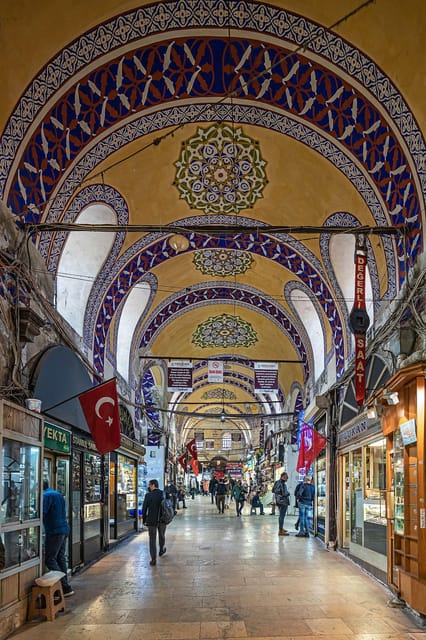
The Grand Bazaar adds commerce and everyday negotiation to the historical route. It is not another imperial monument, but it is part of Istanbul’s long tradition as a trading center. A guided walk helps you understand the bazaar as a place of business rather than just a maze of souvenir shops.
This is also the point where you need to use your judgment. The guide may help with translation, local food purchases, or basic price discussions. One guide even helped a family avoid being overcharged for street food. That kind of assistance can be handy in a busy market.
Still, do not treat a guide’s suggested shop as a guarantee of a fair price. If you buy carpets, jewelry, leather, or other expensive items, compare prices, confirm the total cost before payment, and keep receipts. A serious purchase deserves more time than the final few minutes of a sightseeing tour.
The bazaar is best approached as a place to look, listen, and learn how the sales process works. You do not need to buy something simply because you were shown a shop. If the visit ends here, it is easy to continue exploring on your own afterward.
What the $171 price really covers
At $171 per person, this is not a budget walk. The value depends on how many included entrances you would otherwise buy and how much you want an English-speaking guide to organize the history for you.
The pass includes guided admission to Hagia Sophia, Basilica Cistern, and Topkapi Palace, plus guided visits to the Blue Mosque and Grand Bazaar. It also brings the sights into one route, which saves you from arranging separate tickets, meeting points, and explanations.
The price makes more sense for first-time visitors with limited time, families who want one person to manage the story, or anyone who finds imperial and religious history hard to sort out alone. It is less convincing for independent museum regulars who prefer audio guides, long visits, or the freedom to linger without a group schedule.
A private group is available, which may improve the value for a family or small party. You can ask more questions and move at a comfortable pace. The smaller the group, the more useful the guide’s knowledge becomes.
The pass is valid for three days, and you can join the tour time that suits you from the available timetable. That flexibility helps soften the price, especially if you use the pass to revisit Topkapi or spread the sightseeing across your stay.
Timing, clothing, and meeting-point details
You meet the guide at the stated meeting point rather than receiving hotel pickup. The starting location is the BUSFORUS Istanbul hop-on hop-off tour point, but the exact meeting point and tour time should be checked on the current timetable before you set out.
Bring comfortable shoes. This is a walking tour through several major sites, not a coach excursion.
Bring a headscarf if you need one for mosque entry. Shorts and short skirts are not allowed, and flash photography and backpacks are also listed as prohibited. Follow the guide’s instructions inside each site, since religious buildings and museum rules can differ.
The experience is offered in English. Wheelchair users and people with pre-existing medical conditions should note that it is not considered suitable for them. If you need a slower pace, ask about the private group option before booking.
Cancellation is free up to 24 hours before the activity for a full refund, and you can reserve now and pay later. Those terms are useful if your Istanbul schedule is still changing.
Who will enjoy this museum pass most
I would choose this for a first visit to Istanbul when you want the old city explained rather than merely photographed. It suits families, couples, and small groups who prefer a clear route and regular chances to ask questions.
It is also a good match for history-minded visitors who want connections between Roman, Byzantine, and Ottoman Istanbul. Guides such as Can, Ahmet, Ihsan, and Dilek have been praised for making complicated subjects understandable, answering questions, and adjusting to the group’s pace.
You may want another option if you dislike security lines, want several hours inside each museum, or are mainly interested in shopping. You should also calculate the separate cost of the Topkapi Harem if that room of the palace is essential to your visit.
The biggest practical advantage is the guide. The biggest practical limitation is that the tour cannot control queues at the two mosques. Go in expecting a well-led introduction, not a magic pass past every line.
Should you book the Istanbul Top Museums Guided Pass?
Book it if you want the major Sultanahmet sights covered in one organized visit and you value clear English explanations. The three-day validity gives you room to spread out the experience, while a private group can make the $171 price easier to justify.
Skip it if you are happy researching the monuments yourself, want to spend half a day at Topkapi alone, or dislike guided shopping stops. For most first-time visitors, though, the route offers a sensible historical backbone: Hagia Sophia for religious and imperial change, the Blue Mosque for Ottoman worship and tilework, the Basilica Cistern for engineering, Topkapi for royal power, the Hippodrome for public life, and the Grand Bazaar for trade.
FAQ
How long does the guided pass last?
The guided experience lasts about 2.5 to 3 hours. The museum pass itself remains valid for three days, allowing you to join an available tour time that suits your plans.
Which sights are included?
The experience includes Hagia Sophia, the Blue Mosque, Basilica Cistern, Topkapi Palace, Hippodrome Square, and the Grand Bazaar. Dolmabahce Palace may be added as an option, creating a six-place version.
Is the Topkapi Palace Harem included?
No. The Harem section at Topkapi Palace is not included in the pass.
Does the tour skip the lines at Hagia Sophia and the Blue Mosque?
No. Skip-the-line service is not offered at either site. During peak season, the security line may take around 45 minutes.
What language is the tour offered in?
The live guided tour is offered in English.
What should I bring and wear?
Bring comfortable shoes and a headscarf if needed. Shorts and short skirts are not allowed, and flash photography and backpacks are prohibited.
Just added around Hagia Sophia
- Istanbul: Tour of Hagia Sophia and Blue Mosque By Night★ 4.6 · 30 reviews
- Istanbul’s Iconic Duo: Hagia Sophia & Basilica Cistern★ 4.8 · 30 reviews
- Istanbul: Private photoshoot at Hagia Sophia&Blue Mosque★ 4.7 · 44 reviews
- Istanbul: Hagia Sophia, Blue Mosque, Cistern & Bazaar Tour★ 4.9 · 189 reviews
- Istanbul: Half-Day Morning Hagia Sophia & Blue Mosque Tour★ 3.8 · 27 reviews
- Istanbul: Hagia Sophia Guided Tour★ 4.9 · 78 reviews
- Istanbul: Hagia Sophia, Blue Mosque, & Basilica Cistern Tour★ 4.6 · 21 reviews
- Istanbul: Hagia Sophia Guided Tour with Expert Guide★ 4.9 · 67 reviews
Istanbul Tours, compared.
Bosphorus Dinner Cruise & Show with Private Table
Read our review →
Daytime or Sunset Sightseeing Cruise & Audio Guide
Read our review →
Bosphorus Dinner Cruise with Turkish Night Show
Read our review →
Best of Istanbul 1, 2 or 3-Day Private Guided Istanbul Tour
Read our review →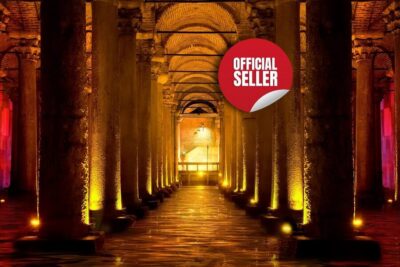
Basilica Cistern Fast-Track Entry and Audio Guide
Read our review →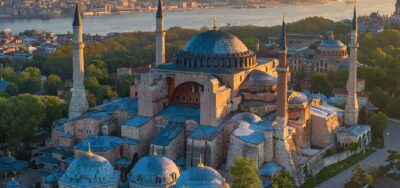
Hagia Sophia Skip-the-Line Ticket & Museum Option
Read our review →
Hodjapasha Whirling Dervishes Show & Exhibition
Read our review →
Topkapi Palace & Harem Museum Ticket & Audio Guide
Read our review →Browse the lists this tour appears in